
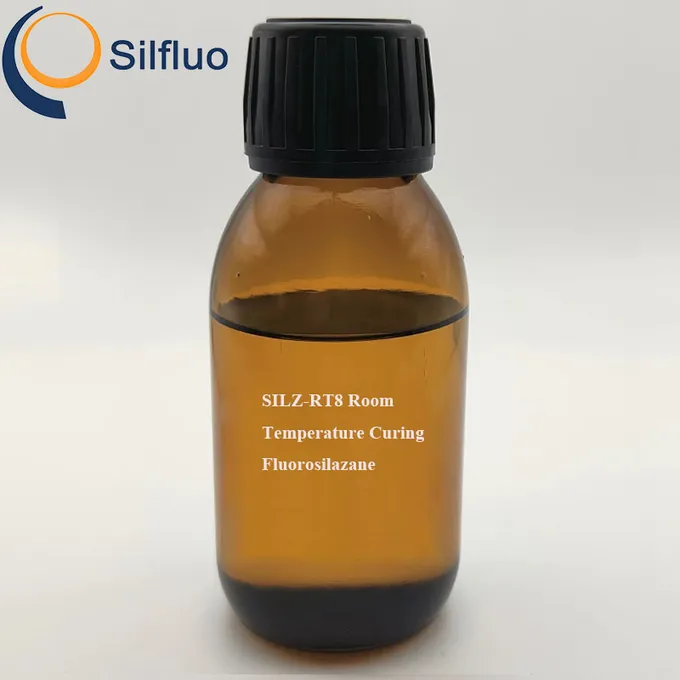
Product Overview
The polysilazane backbone provides what fluoropolymer paints lack — covalent bonding to the substrate, real hardness and -30 to 400 °C service — while the fluoro modification provides what plain polysilazanes lack: a surface that paint, marker, ice and grime struggle to grip. Cure happens at ambient temperature, with an optional 180 °C / 20-minute schedule.
Typical duty: anti-graffiti and easy-to-clean exterior finishes, electronic encapsulation and high-voltage insulation, and outdoor anti-aging protection where both weathering and cleanability are specified.
Key Benefits
≥120° contact angle
Fluoro-modified surface chemistry sheds water, marker ink and adhesives — graffiti wipes off instead of soaking in.
Hard where fluoropolymers are soft
≥6H pencil hardness with Grade 0 covalent adhesion — cleanability without the fragility of wax or PTFE-style topcoats.
-30 to 400 °C service
Full outdoor thermal range with 500 °C instantaneous capability, non-chalking through 30-day accelerated aging.
One-component, ambient cure
Spray and walk away: >24 h full ambient cure, or 180 °C for 20 minutes on a line.
Typical Applications
- Electronic encapsulation
- Outdoor low-surface-energy anti-graffiti/easy-clean coatings
- Electrical insulation
- Wear/fire-resistant topcoats
Solution guides: Electrical Insulation & Electronics ProtectionTransparent, Hard & Easy-Clean Surface Protection
Technical Data
| Test Item | Performance Indicator | Test Method |
|---|---|---|
| Appearance | Light yellow to colorless transparent liquid | GB/T 1721 |
| Solid Content (120 ± 2°C) | >55% | GB/T 1725-2007 |
| Pencil Hardness | ≥6H | GB/T 6739-2006 |
| Adhesion | Grade 0 | GB/T 9286-1998 |
| Neutral Salt Spray Resistance | >500 h | GB/T 1771-2007 |
| Water Contact Angle | ≥120° | GB/T 26490-2011 |
| Artificial Aging Resistance | 30 d: no corrosion, chalking or cracking, slight discoloration | GB/T 1865-2009 |
| Theoretical Coverage | 6–8 m²/kg |
| Dry Film Thickness | 20–150 µm (single pass, ≤150 µm) |
| Room-Temperature Cure | >24 h full cure (surface dry ~1.5 h) |
| Heat Cure Option | 180 °C / 20–30 min |
| Pot Life (after opening) | 4 h |
| Recommended Service Temperature | -30 to 400 °C (500 °C instantaneous) |
| Diluent | Aromatics, esters, ethers |
| Flash Point | <22 °C (solvent) |
| Storage / Shelf Life | 5–30 °C · 12 months |
Values from the SILZ-RT8 technical data sheet. Complete TDS with test conditions available on request.
Curing & Processing Guidance
Prepare to Sa 2.5 (minimum St 3, no mill scale), degrease and dry. Filter the single-component material through a 120-mesh sieve.
Spray in one pass with a 1.0 mm nozzle; target 20–150 µm dry film and do not exceed 150 µm. Pot life after opening is 4 hours, and the cured surface is oleophobic — recoating is not recommended, so plan coverage in one campaign.
Ambient: surface dry ~1.5 h, touch dry >3 h, full cure >24 h. Heat option: 180 °C for about 20 minutes. Cold, dry conditions stretch ambient cure — use the heat schedule when temperature or dew point is marginal.
Substrate Compatibility
Metals, glass, ceramics and coated masonry after standard preparation — anywhere an easy-clean, weatherproof clear finish is wanted. For anti-graffiti programs on public infrastructure, we support test-patch protocols and cleaning-agent compatibility checks.
SILZ-RT8 — Purchasing & Application FAQ
How well does the anti-graffiti effect hold up?
The ≥120° low-surface-energy surface is intrinsic chemistry, not a sacrificial wax — it survives repeated cleaning cycles. Marker and spray paint bead and release with standard solvent wipes; we provide a recommended cleaning protocol with the TDS.
RT8 vs RT7 — which clearcoat do I want?
Lead with the surface property: RT8 for maximum repellency and easy cleaning (≥120°, fluoro-modified, ≥6H); RT7 for maximum hardness and heat-proof clarity (≥8H, 500 °C non-yellowing). Both cure ambient and share the series' adhesion and weathering pedigree.
Why is recoating not recommended?
Once cured, the surface repels almost everything — including a second coat of itself. Achieve your target film in one pass (up to 150 µm), and if a repair is needed later, abrade the area to re-expose a bondable surface first.
TDS / SDS / COA & Samples
Technical Data Sheet, Safety Data Sheet and batch Certificate of Analysis are available for SILZ-RT8, and a COA accompanies every shipment. Evaluation samples ship with starting-parameter guidance.
Packaging: Available in 1 kg, 2 kg, 5 kg and 25 kg pails. Shelf life 12 months at 5–30 °C in the original sealed container.
SDS & batch COA on request · Reply within 1 business day.