
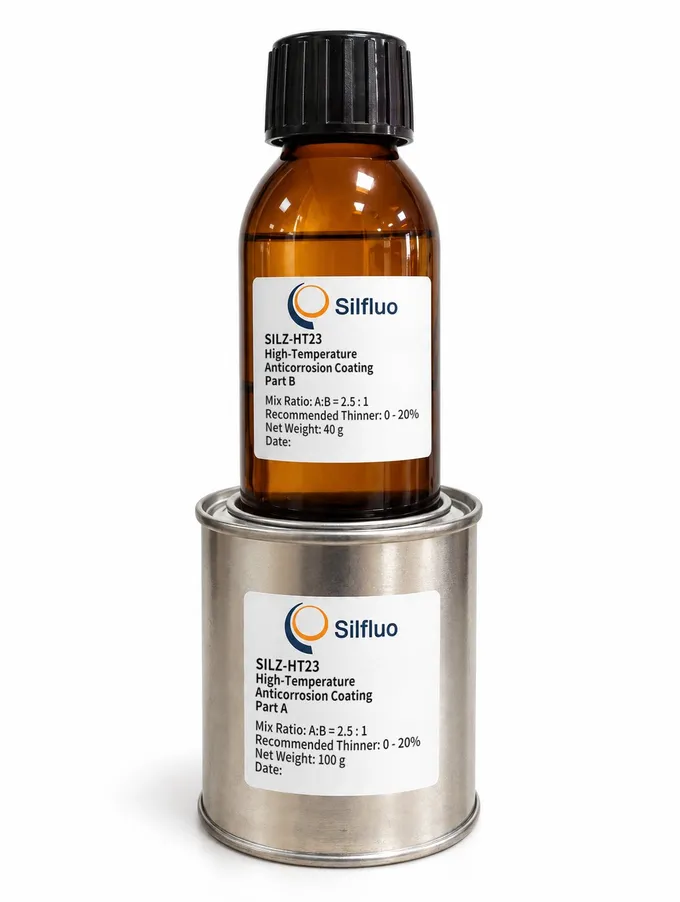
Product Overview
Like HT21, it is an organic-inorganic hybrid: ionic compounds bond covalently to the substrate during cure, lamellar and rod-like fillers block UV and crack growth, and the packed film cures dense with moderate gloss. The white finish adds heat reflection and a clean visual-inspection surface that dark hot-section coatings cannot offer.
Applications mirror the line — chimneys, flues, steam pipelines, exchangers, furnaces, desulfurization and exhaust systems across power, petrochemical, metallurgy, aerospace and defense — wherever a light-colored, inspectable, 600 °C-rated surface is specified.
Key Benefits
White at 600 °C
Titanium-dioxide chemistry holds a bright finish through 30-day artificial aging with only slight color change — rare at this temperature class.
48 h boiling-water verified
A boiling-water result on top of salt spray and acid immersion covers steam-adjacent and wash-down duty.
Extended acid protocol
5% NaCl for 30 days plus H₂SO₄ and HNO₃ for 14 days each, without corrosion.
Thermal-shock proven
More than five 600 °C water-quench cycles without visible cracking — same resilience standard as the rest of the line.
Typical Applications
- Chimneys & flues
- Steam pipelines
- Heat exchangers
- Furnaces
- Desulfurization units
- Cracking units
- Engine & exhaust systems
Solution guides: High-Temperature Corrosion Protection
Technical Data
| Test Item | Performance Indicator | Test Method |
|---|---|---|
| Color | White | — |
| Component Type / Mixing Ratio | Two-component, A:B = 3:1 | — |
| Mixed Viscosity (Ford Cup 4) | 22–26 s | GB/T 1723-1993 |
| Mixed Density | 1.65–1.75 g/cm³ | Measured |
| Pencil Hardness | ≥4H | GB/T 6739-2006 |
| Adhesion | Grade 0 | GB/T 9286-1998 |
| Chemical Resistance | 5% NaCl 30 d / 5% H₂SO₄ 14 d / 5% HNO₃ 14 d: no corrosion | GB/T 9274-1988 |
| Boiling Water Resistance | 48 h: no change | GB/T 1733-1993 |
| Neutral Salt Spray Resistance | 30 d: no blistering, cracking or rust | GB/T 10125-1997 |
| Artificial Aging Resistance | 30 d: no rusting, chalking or cracking, slight color change | GB/T 1865-2009 |
| Thermal Shock Resistance | 600 °C (1 h) → water quench, >5 cycles: no visible cracking | GB/T 30873-2014 |
| Working Time (mixed) | 12 h |
| Service Temperature | Continuous up to 600 °C |
Values from the SILZ-HT23 technical data sheet. Complete TDS with test conditions available on request.
Curing & Processing Guidance
Prepare to Sa 2.5 (minimum St 3, no mill scale), degrease and dry the substrate.
Mix components at exactly A:B = 3:1 to full uniformity, filter, and spray in one thin coat. Use mixed material within 12 hours and clean tools promptly.
Cure on the line schedule — 180 °C / 90 min for sub-400 °C service or 250 °C / 30 min above — after a 10-minute tack-off. Verify color-critical work with a test panel through your actual cure and first heat-up.
Substrate Compatibility
Carbon, alloy and stainless steels in hot service where a light, inspectable finish matters: exchanger shells, steam lines, furnace externals, exhaust housings. Confirm substrate and peak temperature for the matched variant.
SILZ-HT23 — Purchasing & Application FAQ
Why does the 3:1 mixing ratio matter so much?
The ratio balances binder conversion against filler packing. Off-ratio mixes cost hardness, adhesion and — visibly — color stability. Meter by weight, mix to full uniformity, and never eyeball the split.
Will the white color survive service heat?
Through 30-day artificial aging the film shows only slight color change, and the 600 °C thermal-shock protocol leaves it uncracked. Expect gradual, even toning at sustained upper-range temperatures — test panels through your duty cycle tell the exact story.
Can HT23 take direct boiling water or steam contact?
The verified 48-hour boiling-water result covers wash-down and steam-adjacent exposure. For continuous immersion or pressurized steam contact, describe the conditions and we will confirm the system.
TDS / SDS / COA & Samples
Technical Data Sheet, Safety Data Sheet and batch Certificate of Analysis are available for SILZ-HT23, and a COA accompanies every shipment. Evaluation samples ship with starting-parameter guidance.
Packaging: Supplied as matched A/B sets (3:1) in 1 kg, 2 kg, 5 kg and 25 kg pails. Shelf life 6 months at 5–30 °C.
SDS & batch COA on request · Reply within 1 business day.