
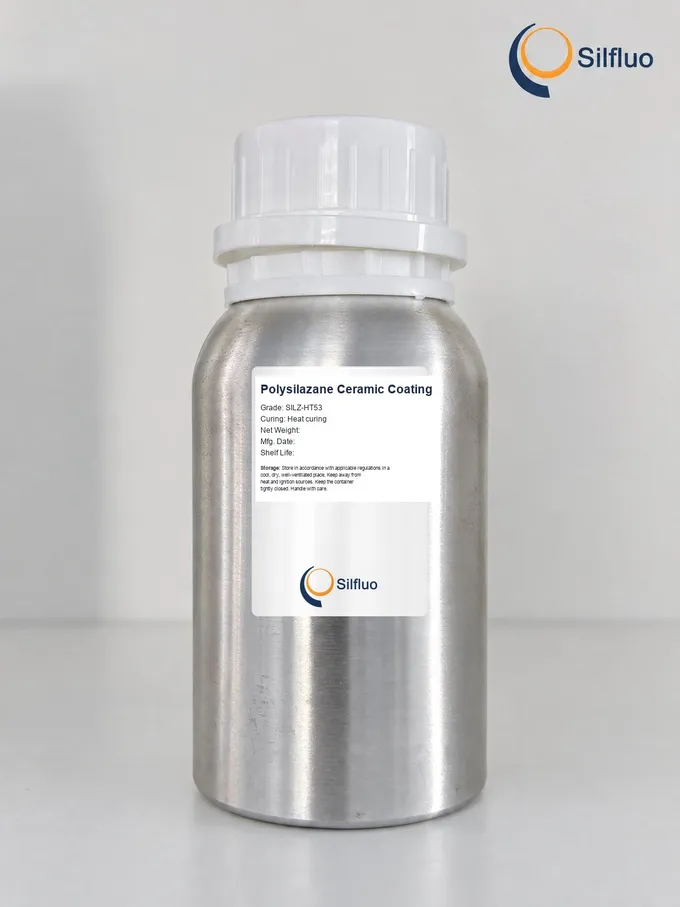
Product Overview
On curing, the polysilazane binder progressively densifies: organic content departs and a dense, wear-resistant inorganic structure forms around the ceramic fillers. Standard curing is 260 °C for 60 minutes in air. Air-cured systems serve up to roughly 700 °C, and a validated nitrogen curing process extends the coating's maximum capability to 1300 °C.
SILZ-HT53 is built for the hot sections of industrial plants — boiler parts, petrochemical furnaces, hot-blast stoves, chimneys, flues and exhaust pipes — as well as heat exchangers, electric-heating elements, molds and metallurgical equipment where paint-type coatings fail.
Key Benefits
-30 to 800 °C recommended service
Continuous service across a wide thermal range with resistance to thermal cycling; a validated nitrogen cure extends maximum capability to 1300 °C.
Ceramic hardness ≥8H
The cured inorganic structure with ceramic fillers produces a dense, wear-resistant film measured at ≥8H pencil hardness.
≥1000 h salt spray resistance
Passed ≥1000 h neutral salt spray with no blistering, rust spots or peeling — corrosion protection that survives heat, not either-or.
Verified 1000 °C / 24 h test
Coating integrity confirmed by a 1000 °C, 24-hour high-temperature test with no peeling or cracking (GB/T 30873-2014).
Thin-film protection
Full protection at 10–40 µm dry film — minimal weight and dimensional impact on precision parts, sensors and heat-transfer surfaces.
Typical Applications
- Boilers & petrochemical furnaces
- Hot-blast stoves
- Chimneys, flues & exhaust pipes
- Molds & casting equipment
- Electric heating elements
- Heat exchangers
- Cookware
Solution guides: High-Temperature Corrosion Protection
Technical Data
| Test Item | Performance Indicator | Test Method |
|---|---|---|
| Coating Appearance | Black-gray | Visual |
| Component Type | Two-component | — |
| Mixed Density | 1.78–1.95 g/cm³ | Measured |
| Mixed Viscosity | 25–38 s | GB/T 1723-1993 |
| Adhesion | Grade 0 | GB/T 9286-1998 |
| Pencil Hardness | ≥8H | GB/T 6739-2006 |
| Neutral Salt Spray Resistance | ≥1000 h: no blistering, rust spots or peeling | GB/T 10125-2021 |
| Artificial Aging Resistance | 30 d: no rust, powdering, cracking or discoloration | GB/T 1865-2009 |
| High-Temperature Test | 1000 °C / 24 h: no peeling or cracking | GB/T 30873-2014 |
| Coating Solids | >85% |
| Theoretical Coverage | 8–15 m²/kg |
| Dry Film Thickness | 10–40 µm (keep ≤35 µm unless validated) |
| Working Time (mixed) | 12 h |
| Curing (air) | 260 °C / 60 min |
| Recommended Service Temperature | -30 to 800 °C |
| Extended Capability | Up to 1300 °C after a validated nitrogen curing process |
| Flash Point | <22 °C (solvent) |
| Storage Temperature / Shelf Life | 5–35 °C · 6 months unopened |
Values from the SILZ-HT53 technical data sheet. Complete TDS with test conditions available on request.
Curing & Processing Guidance
Prepare the substrate to Sa 2.5 (minimum St 3, no mill scale), degrease, and dry. Mix the two components thoroughly at the project-specific ratio supplied with your order, then filter through a 180-mesh screen.
Spray with a 1.0 mm nozzle or apply by a validated scraping process. Keep dry film thickness at or below 35 µm unless a thicker build has been validated for your part — over-thick ceramic films risk cracking during conversion. Use the mixed coating within 12 hours.
Cure at 260 °C for 60 minutes in air as the standard schedule. For service demands above the air-cured range, a nitrogen curing process validated for your application unlocks the 1300 °C maximum. Our engineers provide the curing window and atmosphere parameters for your part geometry.
Substrate Compatibility
High-temperature alloy steels, including 310S and 316 stainless steel. Ultimate coating performance and temperature resistance remain limited by the substrate itself and the curing atmosphere — send us your alloy and target temperature profile for confirmation.
SILZ-HT53 — Purchasing & Application FAQ
Can SILZ-HT53 really withstand 1300 °C?
1300 °C is the maximum capability after a validated nitrogen curing process. With standard air curing at 260 °C, plan around a service ceiling near 700–800 °C. The achievable limit always depends on substrate, film thickness and the actual thermal profile — we confirm it against your conditions.
What is the mixing ratio of the two components?
The ratio is project-specific and is provided with your order and technical documentation. It is tuned to your substrate, curing capability and service temperature rather than published as a universal number.
Why keep the dry film at or below 35 µm?
During high-temperature cure the binder densifies and shrinks. Films thicker than about 35 µm accumulate stress and can crack or spall; the 10–40 µm data range applies only where a thicker build has been validated on your part.
TDS / SDS / COA & Samples
Technical Data Sheet, Safety Data Sheet and batch Certificate of Analysis are available for SILZ-HT53, and a COA accompanies every shipment. Evaluation samples ship with starting-parameter guidance.
Packaging: Available in 1 kg, 2 kg, 5 kg and 25 kg pails (two components packed separately). Shelf life 6 months in original unopened containers at 5–35 °C.
SDS & batch COA on request · Reply within 1 business day.