
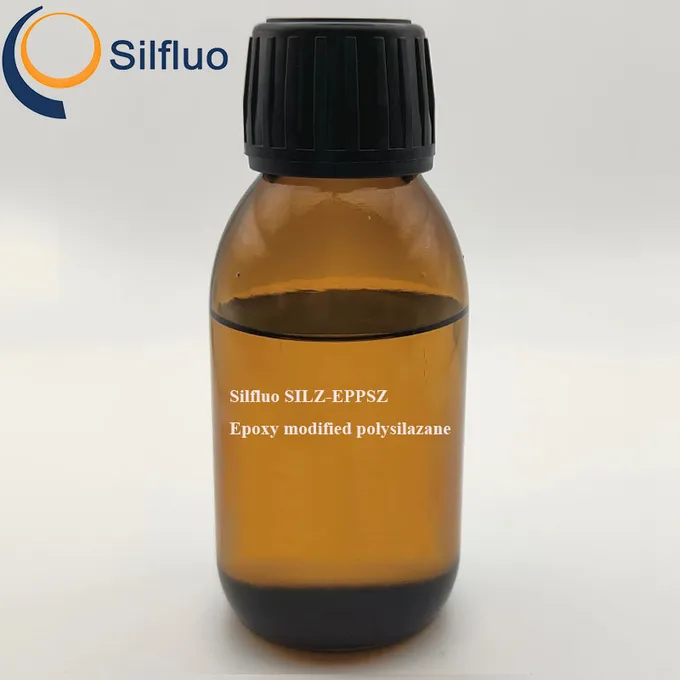
Product Overview
Epoxy segments graft onto the polysilazane backbone, marrying epoxy's bonding and toughness with polysilazane's heat resistance, hardness and non-yellowing weatherability. Cured films form covalent bonds with the substrate — the adhesion mechanism and the adhesive function are the same chemistry.
Use it where a coating must also hold: weather-resistant anticorrosion over structural joints, electrical insulation on heat-resistant components, and bonded assemblies that see -30 to 300 °C service with 500 °C spikes.
Key Benefits
Coating and adhesive in one
≥6H protective film chemistry that doubles as a high-temperature structural bonding system for infrastructure work.
300 °C bonded-joint service
Epoxy toughness that survives where standard epoxy adhesives soften — with 500 °C instantaneous capability.
Generous film window
20–150 µm single-coat build covers thin protective films through gap-filling bond lines.
Insulating and weatherable
≥10⁵ V/mm dielectric strength, ≥105° contact angle and non-yellowing aging for exposed electrical components.
Typical Applications
- High-temperature structural bonding
- Bridge/infrastructure adhesives
- Weather-resistant anticorrosion coatings
- Electrical insulation
- Mechanical protection
Solution guides: Thin-Film & Chemical-Resistant Anti-CorrosionResin, Rubber & Composite Modification
Technical Data
| Test Item | Performance Indicator | Test Method |
|---|---|---|
| Appearance & Color | Transparent to semi-translucent light white liquid | GB/T 1721-79 |
| Solid Content (120 ± 2°C) | >65% | GB/T 1725-2007 |
| Density | 1.00 ± 0.02 g/mL | GB/T 6750-2007 |
| Pencil Hardness | ≥6H | GB/T 6739-2006 |
| Adhesion | Grade 0 | GB/T 9286-1998 |
| Neutral Salt Spray Resistance | >500 h | GB/T 1771-2007 |
| Water Contact Angle | ≥105° | GB/T 26490-2011 |
| Artificial Aging Resistance | 3 d: no rusting, powdering or cracking, slight discoloration | GB/T 1865-2009 |
| Dielectric Strength | ≥10⁵ V/mm | ASTM D149 |
| Theoretical Coverage | 6–8 m²/kg |
| Dry Film Thickness | 20–150 µm (single coat, ≤150 µm) |
| Curing | Room temperature >24 h, or 180 °C <0.5 h |
| Pot Life (after opening) | 3 h |
| Recommended Service Temperature | -30 to 300 °C (500 °C instantaneous) |
| Diluent | Aromatics, esters, ethers |
| Storage Temperature | 0–30 °C |
Values from the SILZ-EPPSZ technical data sheet. Complete TDS with test conditions available on request.
Curing & Processing Guidance
Prepare both faying surfaces (for bonding) or the coating substrate to Sa 2.5 / minimum St 3, degreased and dry. The product is one-component — no mixing; filter before spray application.
Coat at 20–150 µm, or apply as an adhesive layer per joint design. Pot life after opening is 3 hours — decant working quantities and keep the container sealed.
Cure ambient for >24 hours or at 180 °C for under 30 minutes. Bonded structural joints reach handling strength on the same schedule; validate joint strength on your substrate pair with our lap-shear protocol.
Substrate Compatibility
Steel, stainless, cast iron, aluminum and titanium alloys, glass-ceramics, ceramics and cement — as coating or adhesive. For dissimilar-material joints (metal-ceramic, metal-glass), tell us the pair and service temperature for a bonding procedure.
SILZ-EPPSZ — Purchasing & Application FAQ
Is SILZ-EPPSZ primarily a coating or an adhesive?
Both, by design — the covalent substrate bonding that makes it a durable coating is the same chemistry that makes it bond structures. Specify film build for coating duty, joint design for adhesive duty; the cure schedules are identical.
How does it differ from EPPSZ-2K?
EPPSZ is one-component and doubles as an adhesive with a 3-hour pot life. EPPSZ-2K is a two-component, filled ceramic coating tuned for 5000 h-class thin-film anticorrosion — a pure coating, not a bonding system. Shared epoxy-modified chemistry, different jobs.
What joint strength can I expect?
Strength depends on substrate pair, surface preparation and bond-line thickness. We provide lap-shear reference data and a validation protocol with samples rather than quoting a universal number.
TDS / SDS / COA & Samples
Technical Data Sheet, Safety Data Sheet and batch Certificate of Analysis are available for SILZ-EPPSZ, and a COA accompanies every shipment. Evaluation samples ship with starting-parameter guidance.
Packaging: Available in 1 kg, 2 kg, 5 kg and 25 kg pails. Pot life 3 h after opening — decant and reseal. Store at 0–30 °C.
SDS & batch COA on request · Reply within 1 business day.