
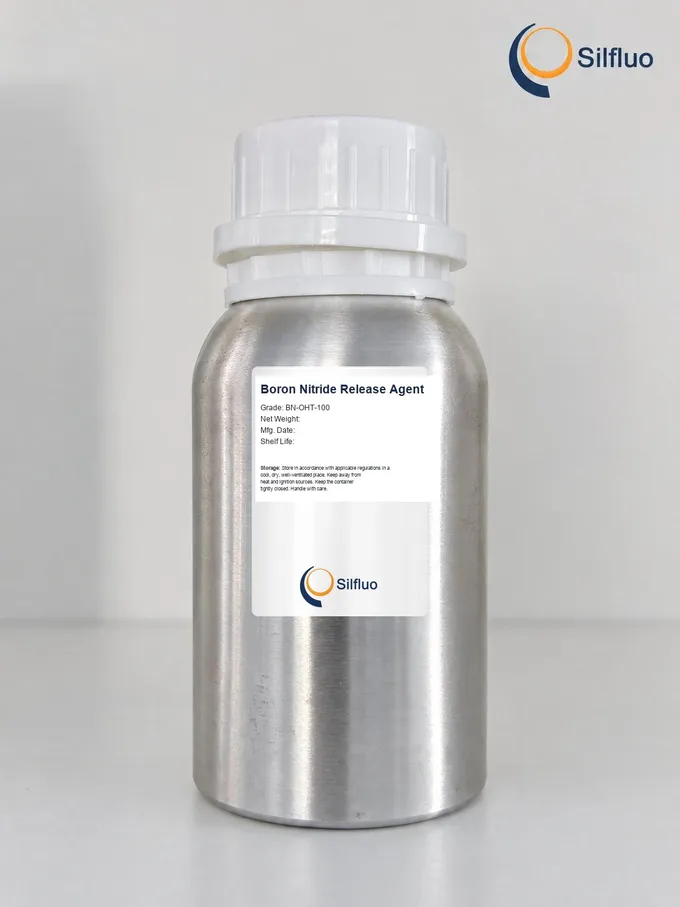
Product Overview
Boron nitride is the working principle: a lamellar solid lubricant that keeps its slip and chemical inertness at temperatures where organic release chemistry has long since decomposed. The modified oil carrier deposits BN evenly as a thin, tough, anti-stick film that resists yellowing and holds to the tool surface (Grade 1 adhesion) instead of transferring to the part.
By process: in glass-bottle and flat-glass forming it prevents sticking at gob-contact temperatures while protecting mold surface finish; on photovoltaic glass tooling it maintains release without contaminating optical surfaces; in high-temperature alloy forging and titanium forming it separates part from die under extreme pressure and heat; and in cast-iron and aluminum foundry work it extends mold cleaning intervals through its semi-permanent effect.
Semi-permanent means the film survives multiple demolding cycles before reapplication — release consistency improves, agent consumption drops, and cycle-time lost to re-spraying shrinks. When release quality finally drifts, a light renewal coat restores the film without stripping.
Key Benefits
Rated to 1500 °C process duty
Boron-nitride lubrication persists through glass-forming, forging and casting temperatures — validated per process before production.
Semi-permanent release film
Multiple demolding cycles per application: lower agent consumption, steadier release quality and fewer spray interruptions.
Clean, non-transferring film
The film stays on the tool (Grade 1 adhesion) rather than the part — critical for glass clarity, PV surfaces and paint-ready castings.
High-flash-point oil carrier
Flash point above 200 °C gives a wide, safer application margin around hot tooling.
One-component spray application
No mixing or dilution: spray from 20–30 cm, rest 1–2 minutes, and the film is ready for service.
Typical Applications
- Mold/tooling release for stainless steel
- Glass & glass bottle forming
- Cast iron, aluminum & titanium alloys
- Superalloys
- Glass-ceramics & ceramics
- Photovoltaic glass
Technical Data
| Test Item | Performance Indicator | Test Method |
|---|---|---|
| Component Type | One-component | — |
| Color & Appearance | Black liquid | GB/T 1721-1979 |
| Solid Content (120 ± 2°C) | >55% | GB/T 1725-2007 |
| Density | 0.83 ± 0.02 g/mL | GB/T 6750-2007 |
| Adhesion | Grade 1 | GB/T 9286-1998 |
| Kinematic Viscosity | 400–600 cSt | — |
| Flash Point | >200 °C | — |
| Application Method | Spray, 20–30 cm distance |
| Rest Time After Spray | 1–2 min |
| Film Type | Thin semi-permanent release film |
| Application Temperature | Room temperature up to 1500 °C (process-validated) |
| Storage / Shelf Life | 5–35 °C · 12 months |
Values from the BN-OHT-100 technical data sheet. Complete TDS with test conditions available on request.
Curing & Processing Guidance
Clean the tool surface of residues from previous release systems — mixed films undermine the semi-permanent effect. A dry, warm (not hot-spraying-wet) surface takes the most even film.
Shake well, then spray a thin, uniform pass from 20–30 cm. Let the film rest 1–2 minutes before the tool re-enters service; the working film builds during the first forming contacts.
Renew with a light pass when release force or surface quality drifts — full stripping is only needed on contaminated or damaged films. Consumption planning: >55% solids at 400–600 cSt covers substantial tool area per kilogram; we help estimate per-mold usage from your geometry.
Substrate Compatibility
Tooling in stainless steel, cast iron, aluminum alloy, titanium alloy and high-temperature alloy steel; forming surfaces for flat glass, glass bottles, glass-ceramics, ceramics and photovoltaic glass. Formulation adjustments are available for process-specific demands — state the formed material, tool alloy and peak temperature.
BN-OHT-100 — Purchasing & Application FAQ
How many release cycles does one application last?
Cycle life depends on forming temperature, pressure and the material being formed — glass-bottle service differs from titanium forging. The semi-permanent film reliably covers multiple cycles in all validated processes; establish your renewal interval with a monitored trial, which we support with a protocol.
Will it contaminate glass or PV surfaces?
The film is designed to stay on the tool, and boron nitride is chemically inert at process temperature. PV glass and optical-clarity glass forming are listed applications; verify with your surface-quality spec using our sample program.
Is 1500 °C really usable, or a laboratory number?
It is the upper bound of available process data, not a universal guarantee — actual performance depends on dwell time, atmosphere and tool material. Every process above common forging temperatures gets a validation trial before production release; that requirement is stated plainly in the TDS.
How does it compare with spray-per-cycle release agents?
Per-cycle agents cost less per liter and more per part: every cycle pays for a spray, an operator interruption and a variability risk. BN-OHT-100 inverts that economics at high temperature — fewer applications, steadier quality — which is why heavy users evaluate it on cost per released part, not price per pail.
TDS / SDS / COA & Samples
Technical Data Sheet, Safety Data Sheet and batch Certificate of Analysis are available for BN-OHT-100, and a COA accompanies every shipment. Evaluation samples ship with starting-parameter guidance.
Packaging: Available in 1 kg, 2 kg, 5 kg and 25 kg containers. Shelf life 12 months at 5–35 °C; shake before use.
SDS & batch COA on request · Reply within 1 business day.