
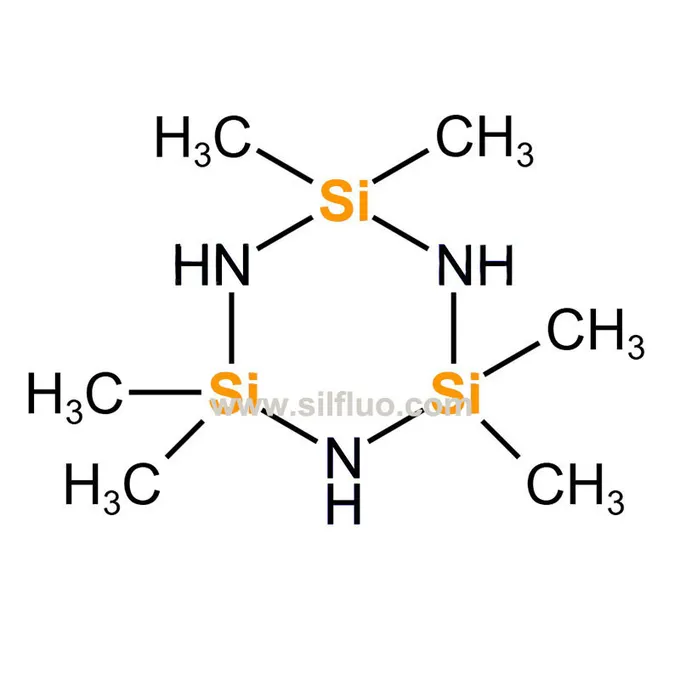
Product Overview
Ring-opening polymerization is the headline use: starting from the clean, defined trimer, polymer makers set molecular weight and architecture on their own terms — the route to high-purity polysilazanes for electronics-adjacent applications. Blended with reactive organosilazanes such as methylhydrosilazane, HMCTS also contributes its Si-N ring chemistry to curable coating systems.
Alongside synthesis duty, Si-N bonds react with hydroxyl compounds — amine-type curing-agent behavior — and modify phenolic, epoxy, alkyd and acrylic resins for heat and weather resistance. In silicone rubber processing HMCTS functions as a structure-control additive that improves vulcanizate strength and heat resistance.
Key Benefits
Defined cyclic trimer, CAS-listed
A clean, single-structure liquid monomer (MW 218–221) with a public CAS registry number — straightforward to qualify, import and register.
Ring-opening polymerization feedstock
The controlled route to high-purity polysilazanes — set your own molecular weight and end-group chemistry.
Photovoltaic & semiconductor pedigree
Used in weather-resistant, self-cleaning protective applications across PV and semiconductor supply chains.
Easy-handling liquid
11 s viscosity flows directly into synthesis reactors, blends and impregnation baths without dilution.
Typical Applications
- PV & semiconductor protective coatings
- Silicone rubber additive
- Polysilazane synthesis monomer
Solution guides: Resin, Rubber & Composite Modification
Technical Data
| Test Item | Performance Indicator | Test Method |
|---|---|---|
| Appearance | Colorless transparent liquid | GB/T 1721-79 |
| Viscosity (Ford Cup 4) | 11 s | GB/T 1723-1993 |
| Purity | ≥96% | Q/YX 10-2023 |
| Solid Content (120 ± 2°C) | >98% | GB/T 1725-2007 |
| Density | 0.92 ± 0.01 g/mL | GB/T 6750-2007 |
| Molecular Weight | 218–221 | GB/T 27843-2011 |
| Pencil Hardness (as film) | ≥2H | GB/T 6739-2006 |
| Adhesion | Grade 0 | GB/T 9286-1998 |
| Salt Spray Resistance | >500 h | GB/T 1771-2007 |
| Physical Form | Liquid cyclic trimer (HMCTS) |
| Cure Behavior | Low Si-CH₃ reactivity — blend with reactive organosilazanes to thermally cure |
| Cure @165–250 °C (blended, DFT 5–25 µm) | Surface dry 1 h → 0.1 h · full cure 1 h → 0.5 h |
Values from the SILZ-CY-3 technical data sheet. Complete TDS with test conditions available on request.
Curing & Processing Guidance
Handle under dry, inert conditions — the Si-N ring is moisture-reactive, and purity is the product. Keep containers sealed and transfer with dry equipment.
SILZ-CY-3 does not thermally cure on its own: Si-CH₃ groups are low-reactivity by design. For film or ceramic work, blend with reactive organosilazanes (e.g., methylhydrosilazane SILZ-701); blended systems follow the standard 165–250 °C cure window with surface-dry from 1 hour down to 6 minutes.
For ring-opening polymerization, catalyst choice and conditions define your polymer architecture — our lab shares starting conditions for common target molecular weights.
Substrate Compatibility
Primarily a synthesis and compounding raw material — the "substrate" is your reactor or resin system. As part of blended coating systems, standard metallic and ceramic substrates apply after conventional preparation.
SILZ-CY-3 — Purchasing & Application FAQ
What is the difference between SILZ-CY-3 and SILZ-CY-4?
Same chemistry family, different ring size and physical form: CY-3 (HMCTS) is a liquid trimer, easiest to dose and react; CY-4 (OMCTS) is a solid tetramer with a defined boiling point, preferred where its melting/boiling behavior or tetramer ring suits the synthesis. Many synthesis routes qualify both and choose by process convenience.
Can SILZ-CY-3 be used directly as a coating?
Not alone — Si-CH₃ groups make it hard to thermally cure by itself. Blend it with reactive organosilazanes (such as methylhydrosilazane) to build curable films.
What purity and documentation ship with it?
≥96% purity to Q/YX 10-2023, with TDS, SDS and batch COA. If your semiconductor or PV workflow needs tighter specification windows, talk to us about qualification lots.
TDS / SDS / COA & Samples
Technical Data Sheet, Safety Data Sheet and batch Certificate of Analysis are available for SILZ-CY-3, and a COA accompanies every shipment. Evaluation samples ship with starting-parameter guidance.
Packaging: Available in 1 kg, 2 kg, 5 kg and 25 kg sealed containers. Keep dry and tightly closed at all times.
SDS & batch COA on request · Reply within 1 business day.