
Product Overview
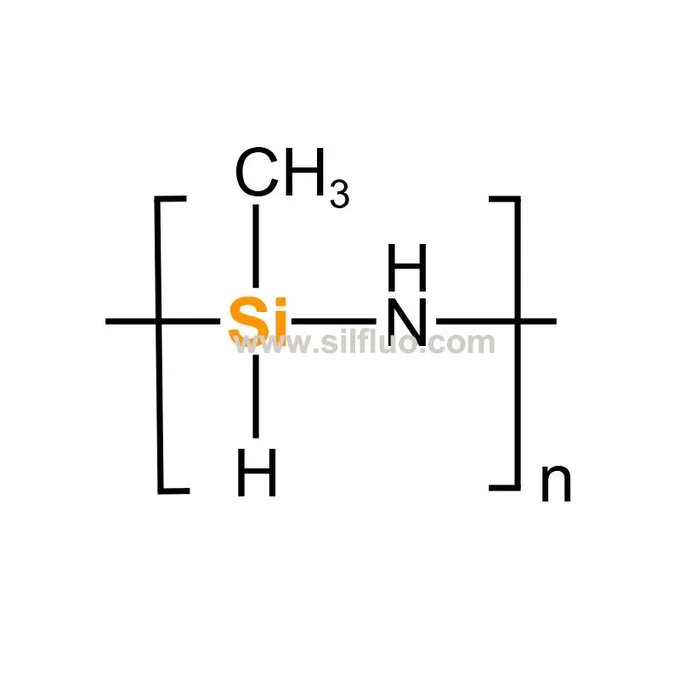
The dual functionality is the point: Si-H sites drive hydrosilylation with unsaturated olefins, while Si-N and Si-H bonds react readily with hydroxyl-containing substances — so one resin covers amine-type curing-agent duty and heat-resistance modification of phenolic, epoxy, alkyd and acrylic systems.
As a coating binder it delivers ≥6H hardness and >500 h salt spray from a thin 10 µm-class film, serving continuously at 350 °C; compounded with heat-resistant nanofillers it withstands direct flame and high-temperature airflow erosion.
Key Benefits
Dual Si-H / Si-vinyl reactivity
Hydrosilylation sites plus vinyl unsaturation in one molecule — a self-contained crosslinking pair for hybrid resin systems.
High-molecular-weight grade
Relative molecular mass >8×10⁴ builds film integrity and mechanical strength that low-MW silazanes cannot match.
Heat-resistance modifier
Reacts into phenolic, epoxy, alkyd and acrylic systems to lift their thermal and weathering performance without a separate curing agent.
Thin-film protection at 350 °C
A cured 10 µm-class film gives ≥6H hardness, >500 h salt spray and continuous 350 °C service with 500 °C excursions.
Typical Applications
- Heat-curable protective films
- Flame/high-temperature airflow-resistant coatings with nanofillers
- Heat/weather-resistance modification of phenolic, epoxy, alkyd and acrylic resins
Solution guides: Resin, Rubber & Composite Modification
Technical Data
| Test Item | Performance Indicator | Test Method |
|---|---|---|
| Color & Appearance | Pale yellow to colorless transparent liquid | GB/T 1721-1979 |
| Viscosity (Ford Cup 4) | 35–50 s | GB/T 1723-1993 |
| Purity | ≥95% | Q/YX 10-2023 |
| Solid Content (120 ± 2°C) | >98% | GB/T 1725-2007 |
| Density | 1.05 ± 0.01 g/mL | GB/T 6750-2007 |
| Relative Molecular Mass | >8×10⁴ | GB/T 27843-2011 |
| Pencil Hardness | ≥6H | GB/T 6739-2006 |
| Adhesion | Grade 0 | GB/T 9286-1998 |
| Salt Spray Resistance | >500 h | GB/T 10125-2021 |
| Reactive Groups | Si-H + Si-vinyl (methylhydro- & methylvinylsilazane) |
| Dilution | High viscosity — 50% dilution recommended before application |
| Theoretical Coverage | 12–28 m²/kg |
| Curing Temperature | 180–250 °C |
| Curing Time | 1 h |
| Dry Film Thickness | 10 ± 5 µm (keep ≤15 µm) |
| Working Time (after opening) | 24 h |
| Recommended Operating Temperature | -30 to 300 °C (continuous 350 °C, max 500 °C) |
| Thinner | Aromatics, esters, ethers |
| Flash Point | <22 °C (solvent) |
| Storage Temperature | 0–30 °C |
Values from the SILZ-350 technical data sheet. Complete TDS with test conditions available on request.
Curing & Processing Guidance
SILZ-350 is supplied as a high-viscosity varnish (35–50 s, Ford Cup 4); dilute about 50% with aromatic, ester or ether solvents before spraying. Prepare metal substrates to Sa 2.5 (minimum St 3) and ensure a clean, dry surface.
Apply one thin coat targeting 10 ± 5 µm dry film and do not exceed 15 µm — the film densifies during cure, and over-thick films lose performance. Theoretical coverage runs 12–28 m²/kg diluted.
Cure at 180–250 °C for about 1 hour. Opened material stays workable for 24 hours; clean tools promptly. Where your process runs a non-standard oven profile, our lab supports cure-schedule design against your line capability.
Substrate Compatibility
Carbon steel, stainless steel, cast iron, aluminum alloy, titanium alloy, high-temperature alloy steel, glass-ceramics, ceramics and cement. As a resin modifier, compatibility is defined by your matrix system — send us the resin system and target service temperature.
SILZ-350 — Purchasing & Application FAQ
What is the difference between SILZ-350 and SILZ-702?
Both are high-molecular-weight heat-curing silazanes with near-identical film data. SILZ-350 carries Si-H plus vinyl groups (methylhydro- and methylvinylsilazane), giving it a built-in hydrosilylation pair; SILZ-702 is Si-H only. Choose 350 when you want self-crosslinking or vinyl reactivity, 702 when a pure Si-H feedstock fits your chemistry.
Can SILZ-350 act as a curing agent for hydroxyl-functional resins?
Yes. Si-N and Si-H bonds react with hydroxyl groups, so SILZ-350 can take amine-type curing-agent duty in phenolic, epoxy, alkyd and acrylic systems while simultaneously raising heat and weather resistance. Dosage depends on the hydroxyl value of your binder — send the resin data sheet and our lab proposes a starting ratio.
Why must the film stay below 15 µm?
Silazane coatings shrink as they densify during heat cure. Above roughly 15 µm the film accumulates stress and performance drops — build thickness with system design (fillers, multiple thin coats validated per application), not one thick pass.
TDS / SDS / COA & Samples
Technical Data Sheet, Safety Data Sheet and batch Certificate of Analysis are available for SILZ-350, and a COA accompanies every shipment. Evaluation samples ship with starting-parameter guidance.
Packaging: Available in 1 kg, 2 kg, 5 kg and 25 kg pails. Store at 0–30 °C in the original sealed container.
SDS & batch COA on request · Reply within 1 business day.