
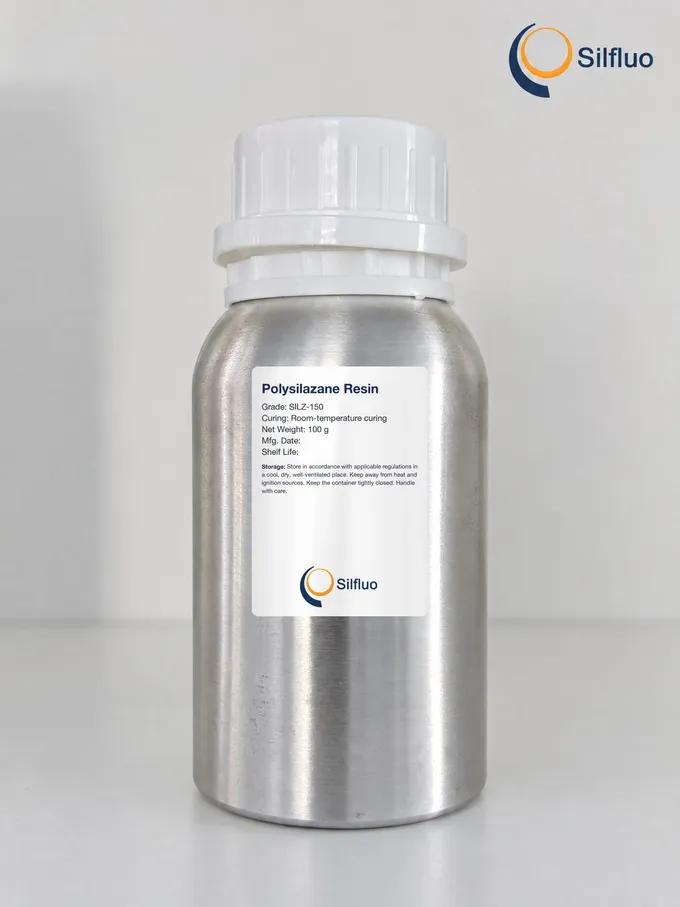
Product Overview
Curing proceeds by hydrolysis and oxidation of Si-NH-Si groups in ambient humidity — no oven, no second component. The same groups react with hydroxyl groups on the substrate surface, so adhesion is built on covalent bonds rather than mechanical anchoring alone. With a suitable catalyst, additional Si-H and Si-NH-Si reactions form a denser three-dimensional network for higher mechanical performance.
For coating formulators, SILZ-150 also works as a reactive building block: it can serve as an amine-type curing agent, or modify hydroxyl-functional phenolic, epoxy, alkyd and acrylic resins to raise their heat and weather resistance. This dual role — finished-coating binder and formulation intermediate — is why the SILZ-150 series anchors our resin line.
Key Benefits
True room-temperature cure
Surface-dry in about 30 minutes, full cure in >18 hours at ambient conditions — no baking step, suitable for on-site application and heat-sensitive substrates.
≥6H hardness, non-yellowing
The cured film combines pencil hardness of ≥6H with a colorless, transparent appearance that resists yellowing outdoors.
Covalent adhesion to diverse substrates
Si-NH-Si groups bond chemically with surface hydroxyls on metals, glass, ceramics and cementitious materials, achieving Grade 0 adhesion.
Electrical insulation grade
Dielectric strength ≥10⁵ V/mm and volume resistivity ≥10¹² Ω·m support insulating and electronics-adjacent coating designs.
Formulation flexibility
Usable neat as a clear protective binder, or blended into phenolic, epoxy, alkyd and acrylic systems as a heat- and weather-resistance modifier.
Typical Applications
- Insulating coatings
- Wear-resistant coatings
- Flame-retardant coatings
- Hydrophobic self-cleaning coatings
- Weather-resistant & antibacterial coatings
- Amine curing agent
- Resin modifier
Solution guides: Electrical Insulation & Electronics ProtectionTransparent, Hard & Easy-Clean Surface ProtectionResin, Rubber & Composite Modification
Technical Data
| Test Item | Performance Indicator | Test Method |
|---|---|---|
| Color & Appearance | Pale yellow to colorless transparent liquid | GB/T 1721-1979 |
| Solid Content (120 ± 2°C) | >97% | GB/T 1725-2007 |
| Density | 0.93 ± 0.1 g/cm³ | GB/T 6750-2007 |
| Pencil Hardness | ≥6H | GB/T 6739-2006 |
| Adhesion | Grade 0 | GB/T 9286-1998 |
| Neutral Salt Spray Resistance | >500 h | GB/T 10125-2021 |
| Hydrophobic Contact Angle | >100° | GB/T 26490-2011 |
| Artificial Aging Resistance | 30 d: no rust, powdering, cracking or discoloration | GB/T 1865-2009 |
| Dielectric Strength | ≥10⁵ V/mm | ASTM D149 |
| Volume Resistivity | ≥10¹² Ω·m | GB/T 35856-2018 |
| Theoretical Coverage | 8–15 m²/kg |
| Dry Film Thickness | 20–70 µm |
| Working Time (after opening) | 4 h |
| Curing Temperature | Room temperature |
| Curing Time (full dry) | >18 h |
| Recommended Operating Temperature | -30 to 350 °C |
| Maximum Instantaneous Temperature | 500 °C |
| Thinner | Aromatics, esters, ethers |
| Flash Point | <22 °C |
| Storage Temperature / Shelf Life | 5–35 °C · 12 months unopened |
Values from the SILZ-150 technical data sheet. Complete TDS with test conditions available on request.
Curing & Processing Guidance
Surface preparation drives coating performance. Grind or sandblast to Sa 2.5 (minimum St 3, no mill scale, per GB/T 30790.4-2014), remove oil and dust with a degreaser, and make sure the surface is fully dry before application.
SILZ-150 is single-component: take the required amount, filter through a 120-mesh sieve if needed, and spray with a 1.0 mm nozzle for the most uniform films. Apply one coat where possible and keep dry film thickness at or below 70 µm — thicker films can reduce coating performance. The cured surface is hydrophobic and oleophobic, so recoating over a cured film is not recommended.
At room temperature the coating is surface-dry in about 30 minutes, touch-dry after 2 hours and fully cured after 18 hours. Once the container is opened, use the material within 4 hours and keep tools clean to prevent unintended curing.
Substrate Compatibility
Carbon steel, stainless steel, cast iron, aluminum alloy, titanium alloy, high-temperature alloy steel, glass-ceramics, ceramics and cement. Different substrates may call for adjusted formulations — tell us your substrate and service conditions and we will confirm the right system.
SILZ-150 — Purchasing & Application FAQ
How long can I use SILZ-150 after opening the container?
Plan application within 4 hours of opening. The resin cures with ambient moisture, so reseal partial containers immediately and keep tools clean — cured material cannot be redissolved.
What film thickness should I target?
Aim for a dry film of 20–70 µm in a single coat. Stay at or below 70 µm: over-thick films may lose hardness and adhesion during cure, and recoating over the cured hydrophobic surface is not recommended.
What is the difference between SILZ-150 and SILZ-150K?
Both are room-temperature curing polysilazane resins from the same family. SILZ-150 is the slow-cure grade with a longer working window; SILZ-150K is the rapid-cure grade for faster production takt. Choose by your line speed and application window, or ask us with your process details.
Does SILZ-150 need a primer or a catalyst?
No primer: adhesion comes from covalent bonding with substrate hydroxyl groups. Catalysts are optional — a suitable catalyst accelerates the Si-H/Si-NH-Si network for higher crosslink density. Contact our engineers for catalyst guidance for your system.
TDS / SDS / COA & Samples
Technical Data Sheet, Safety Data Sheet and batch Certificate of Analysis are available for SILZ-150, and a COA accompanies every shipment. Evaluation samples ship with starting-parameter guidance.
Packaging: Available in 1 kg, 2 kg, 5 kg and 25 kg pails. Shelf life 12 months in the original unopened container at 5–35 °C.
SDS & batch COA on request · Reply within 1 business day.