
Product Overview
The engineering is in the filler architecture: lamellar and rod-like structures interlock against UV and crack propagation, phosphates inhibit corrosion, and ionic compounds form covalent bonds to the substrate during cure — mechanical strength and adhesion beyond conventional heat-resistant paints.
HT21 is the black workhorse of our oven-cured line, protecting chimneys and flue ducts, steam pipelines, heat exchangers, furnaces, desulfurization units, cracking equipment, engine components and exhaust systems across power, petrochemical, metallurgy, aerospace and defense programs.
Product Video
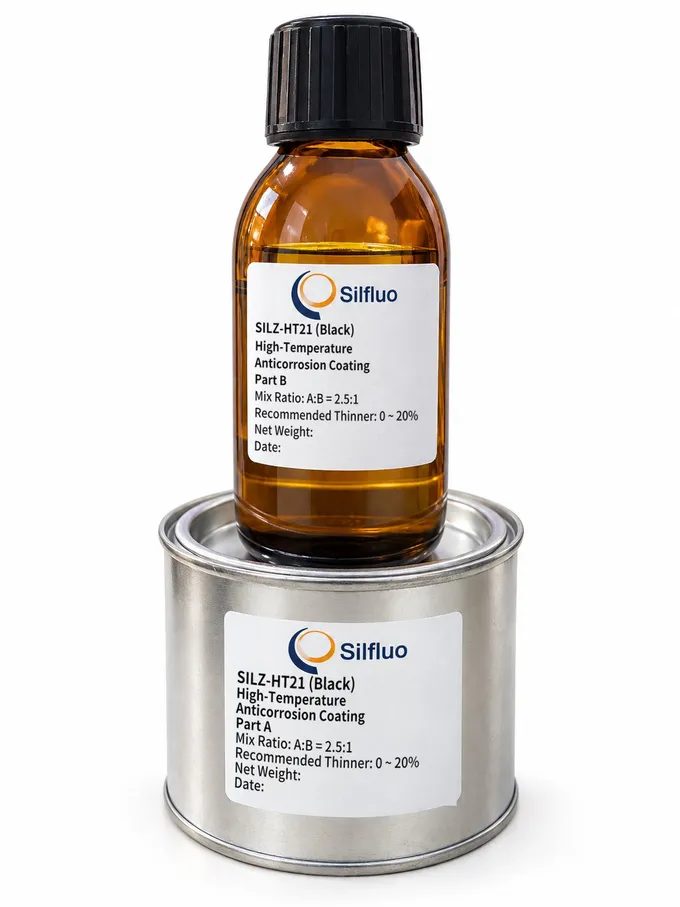
SILZ-HT21 nano-ceramic coating: two-component kit and coated parts
Key Benefits
600 °C continuous, thermal-shock proven
More than five cycles of 600 °C into water quench without visible cracking — validated resilience for cycling hot sections.
30-day triple-acid endurance
5% NaCl, H₂SO₄ and HNO₃ immersion for 30 days without corrosion, alongside 30-day neutral salt spray.
Thin 20–30 µm build
Full protection in a single thin coat — minimal weight and heat-transfer penalty on exchangers and piping.
Practical oven schedule
180 °C / 90 min for sub-400 °C duty or 250 °C / 30 min for hotter service — schedules ordinary coating shops can run.
Typical Applications
- Chimneys & steam pipelines
- Heat exchangers
- Furnaces
- Desulfurization units
- Cracking units
- Engine & exhaust components
Solution guides: High-Temperature Corrosion Protection
Technical Data
| Test Item | Performance Indicator | Test Method |
|---|---|---|
| Component A / B Appearance | Clear liquid / black paste | — |
| Component Type | Two-component | — |
| Mixed Viscosity (Ford Cup 4) | 22–26 s | GB/T 1723-1993 |
| Mixed Density | 1.70 ± 0.05 g/mL | GB/T 6750-2007 |
| Solid Content (180 ± 2°C) | >60% | GB/T 1725-2007 |
| Pencil Hardness | ≥4H | GB/T 6739-2006 |
| Adhesion | Grade 0 | GB/T 9286-1998 |
| Neutral Salt Spray Resistance | 30 d: no blistering, cracking or rust | GB/T 10125-1997 |
| Thermal Shock Resistance | 600 °C (1 h) → water quench, >5 cycles: no visible cracking | GB/T 30873-2014 |
| Chemical Resistance | 5% NaCl / H₂SO₄ / HNO₃, 30 d: no corrosion | GB/T 9274-1988 |
| Dry Film Thickness | 20–30 µm (single coat, ≤30 µm) |
| Curing (service <400 °C) | 180 °C / 90 min (after 10 min tack-off) |
| Curing (service >400 °C) | 250 °C / 30 min |
| Working Time (mixed) | 12 h |
| Service Temperature | Continuous up to 600 °C |
| Storage / Shelf Life | 5–30 °C · 6 months |
Values from the SILZ-HT21 technical data sheet. Complete TDS with test conditions available on request.
Curing & Processing Guidance
Prepare steel to Sa 2.5 (minimum St 3, no mill scale), degrease, dry. Mix the two components, shake thoroughly and filter through a 400-mesh sieve; mixed material stays usable 12 hours.
Spray with a 0.5–1.0 mm nozzle in one coat at 20–30 µm dry film — do not exceed 30 µm.
Let the film tack off for 10 minutes, then cure: 180 °C for 90 minutes where service stays below 400 °C, or 250 °C for 30 minutes for service above 400 °C. First heat-up to operating temperature completes densification.
Substrate Compatibility
Carbon steel, alloy and stainless steels in hot corrosive service — flues, steam lines, exchangers, furnace shells, desulfurization and exhaust equipment. Confirm alloy and peak temperature; formulation variants cover specific substrate classes.
SILZ-HT21 — Purchasing & Application FAQ
HT21 or HT23 — what is the practical difference?
Performance class is shared (600 °C continuous, 30 d salt spray, >5 thermal-shock cycles). HT21 cures black with sericite-mica filler architecture; HT23 cures white with mica/titanium-dioxide fillers, adds a 48 h boiling-water result and specifies a 3:1 mixing ratio. Choose by color requirement first, then by which verified test matters to your duty cycle.
Why two cure schedules?
The 180 °C / 90 min schedule fully serves coatings operating below 400 °C. Duty above 400 °C needs the denser conversion of the 250 °C / 30 min schedule. Pick the schedule matching your service temperature, not your oven convenience.
What happens if the film goes on thicker than 30 µm?
Ceramic-forming films shrink during cure; beyond 30 µm the stress can crack or delaminate the coating. Build to specification in one pass — thickness comes from the system design, not extra material.
TDS / SDS / COA & Samples
Technical Data Sheet, Safety Data Sheet and batch Certificate of Analysis are available for SILZ-HT21, and a COA accompanies every shipment. Evaluation samples ship with starting-parameter guidance.
Packaging: Supplied as matched two-component sets in 1 kg, 2 kg, 5 kg and 25 kg pails. Shelf life 6 months at 5–30 °C.
SDS & batch COA on request · Reply within 1 business day.