
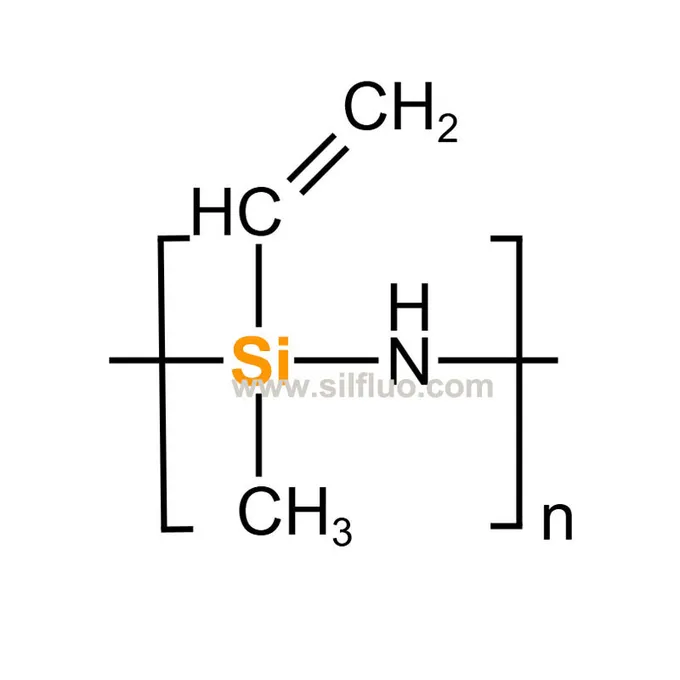
Product Overview
At 11 s (Ford Cup 4) and molecular weight 255–591, SILZ-351 is the mobile, reactive end of our silazane line. Addition reactions at the vinyl group adjust viscosity and molecular weight or introduce new functional groups — the practical route to custom silazane chemistry without starting from chlorosilanes.
Beyond synthesis work, the Si-N bonds react with hydroxyl compounds for amine-type curing-agent duty and heat-resistance modification of phenolic, epoxy, alkyd and acrylic resins. In rubber processing it acts as a structural optimization agent while lifting the heat resistance and mechanical strength of vulcanizates.
Key Benefits
Vinyl reactivity on tap
Pendant C=C sites accept hydrosilylation and other addition reactions — build molecular weight, tune viscosity or graft new functionality.
Low viscosity, easy dosing
11 s Ford Cup 4 flows into compounding, impregnation and synthesis workflows without dilution.
Rubber processing additive
Structure-control agent in silicone rubber that also raises heat resistance and mechanical strength of the vulcanized compound.
Fast heat cure when filmed
As a coating it surface-dries in 6 minutes at 200 °C and fully cures in half an hour, reaching ≥4H hardness and >500 h salt spray.
Typical Applications
- Modifier for unsaturated-olefin resins
- Silicone rubber structural control agent
- Heat-resistance additive
Solution guides: Resin, Rubber & Composite Modification
Technical Data
| Test Item | Performance Indicator | Test Method |
|---|---|---|
| Appearance | Light yellow to colorless transparent liquid | GB/T 1721-79 |
| Viscosity (Ford Cup 4) | 11 s | GB/T 1723-1993 |
| Purity | ≥95% | Q/YX 10-2023 |
| Solid Content (120 ± 2°C) | >96% | GB/T 1725-2007 |
| Density | 1.02 ± 0.01 g/mL | GB/T 6750-2007 |
| Molecular Weight | 255–591 | GB/T 27843-2011 |
| Pencil Hardness | ≥4H | GB/T 6739-2006 |
| Adhesion | Grade 0 | GB/T 9286-1998 |
| Salt Spray Resistance | >500 h | GB/T 1771-2007 |
| Reactive Groups | Si-vinyl (methylvinylsilazane) |
| Curing Temperature | 165–250 °C |
| Cure @165 °C (DFT 5–25 µm, RH 50%) | Surface dry 1 h · full cure 1 h |
| Cure @200–250 °C | Surface dry 0.1 h · full cure 0.5 h |
Values from the SILZ-351 technical data sheet. Complete TDS with test conditions available on request.
Curing & Processing Guidance
For synthesis and compounding use, dose SILZ-351 under dry conditions and keep containers sealed — Si-N bonds are moisture-reactive by design.
As a film former, apply thin (5–25 µm dry film) and cure by heat: at 165 °C surface dry takes 1 hour and full cure 1 hour; at 200–250 °C surface dry drops to about 6 minutes with full cure in 30 minutes (50% RH reference).
In rubber processing, add during compounding per your recipe trials; typical loadings are small. Our lab provides starting dosage recommendations for silicone and other synthetic rubber systems.
Substrate Compatibility
As a coating: carbon steel, stainless steel and common metallic or ceramic substrates. As a reactive intermediate: unsaturated resins, silicone rubber compounds and hydroxyl-functional resin systems — compatibility follows your matrix chemistry rather than a substrate list.
SILZ-351 — Purchasing & Application FAQ
When do I pick SILZ-351 over SILZ-701?
Pick by reactive group: SILZ-351 offers vinyl (C=C) sites for addition chemistry; SILZ-701 offers Si-H sites for hydrosilylation. They are frequently used together as a complementary pair — 701's Si-H adds across 351's vinyl — to build crosslinked networks during heat cure.
Can SILZ-351 and SILZ-701 be used together?
Yes — that is the standard pairing. SILZ-701's Si-H adds across SILZ-351's vinyl groups by hydrosilylation, so the blend crosslinks into a coherent network during heat cure instead of relying on moisture. We provide compounding ratios as starting points.
How is it dosed in silicone rubber processing?
As a processing additive at small loadings established by compounding trials — it functions as a structure-control agent and improves heat resistance and mechanical strength of the vulcanizate. Tell us your gum system and cure chemistry for a starting dosage.
TDS / SDS / COA & Samples
Technical Data Sheet, Safety Data Sheet and batch Certificate of Analysis are available for SILZ-351, and a COA accompanies every shipment. Evaluation samples ship with starting-parameter guidance.
Packaging: Available in 1 kg, 2 kg, 5 kg and 25 kg pails. Keep tightly sealed; the material is moisture-reactive.
SDS & batch COA on request · Reply within 1 business day.