
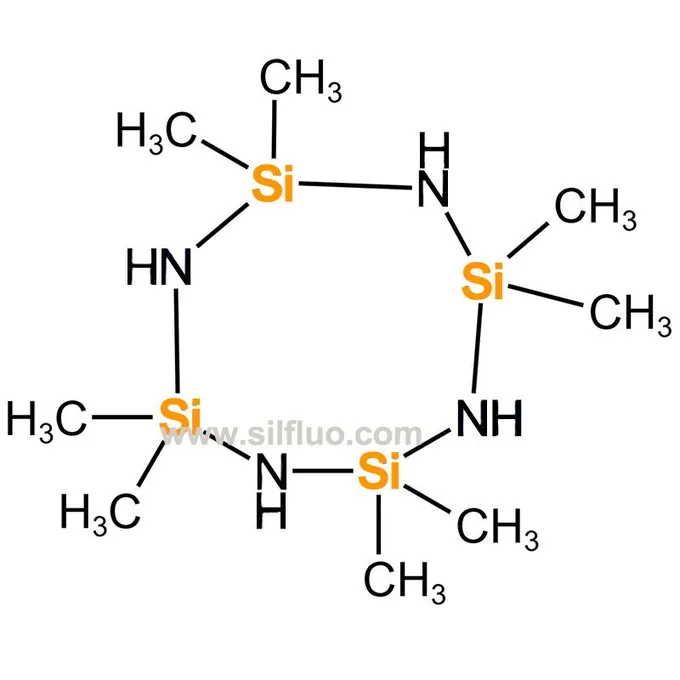
Product Overview
The tetramer ring and crystalline solid form are the differentiators: a defined melting/boiling window suits purification-by-distillation workflows and processes that meter solids. Ring-opening polymerization from OMCTS gives polymer makers controlled molecular weight from a clean single structure, and blending with methylhydrosilazane opens the way to curable coating systems.
Si-N reactivity carries the same secondary uses as the rest of the line: amine-type curing agent, heat- and weather-resistance modifier for hydroxyl-functional resins, and structure-control additive in silicone and synthetic rubber processing.
Key Benefits
Defined solid tetramer, CAS-listed
White crystalline OMCTS (MW 290–295) with a public CAS number and a sharp 225 ± 2 °C boiling point — friendly to distillation-based purification and QC.
Ring-opening polymerization feedstock
Controlled-architecture route to high-purity polysilazanes for electronics-adjacent applications.
Solid form, clean metering
A crystalline solid rather than a varnish — weighed and charged without solvent handling, and purified by distillation against a sharp boiling point.
Resin & rubber modifier
Amine-type curing behavior and heat/weather-resistance upgrades for phenolic, epoxy, alkyd and acrylic systems; proven silicone-rubber processing additive.
Typical Applications
- PV & semiconductor weather-resistant/self-cleaning coatings
- Silicone rubber additive
- Polysilazane synthesis monomer
Solution guides: Resin, Rubber & Composite Modification
Technical Data
| Test Item | Performance Indicator | Test Method |
|---|---|---|
| Appearance | White crystalline solid | GB/T 1721-79 |
| Boiling Point (756 mmHg) | 225 ± 2 °C | GB/T 616-2006 |
| Purity | ≥96% | Q/YX 10-2023 |
| Solid Content (120 ± 2°C) | >98% | GB/T 1725-2007 |
| Density | 0.95 ± 0.01 g/mL | GB/T 6750-2007 |
| Molecular Weight | 290–295 | GB/T 27843-2011 |
| Pencil Hardness (as film) | ≥2H | GB/T 6739-2006 |
| Adhesion | Grade 0 | GB/T 9286-1998 |
| Salt Spray Resistance | >500 h | GB/T 1771-2007 |
| Physical Form | Solid cyclic tetramer (OMCTS) |
| Cure Behavior | Low Si-CH₃ reactivity — blend with reactive organosilazanes to thermally cure |
| Cure @165–250 °C (blended, DFT 5–25 µm) | Surface dry 1 h → 0.1 h · full cure 1 h → 0.5 h |
Values from the SILZ-CY-4 technical data sheet. Complete TDS with test conditions available on request.
Curing & Processing Guidance
Store and handle dry: the crystalline solid is moisture-sensitive at its Si-N bonds. Melt or dissolve under inert, dry conditions per your process design.
SILZ-CY-4 does not thermally cure alone — blend with reactive organosilazanes for curable systems. Blends follow the 165–250 °C window: surface dry from 1 hour at 165 °C down to about 6 minutes at 200–250 °C, full cure 0.5–1 hour (DFT 5–25 µm reference).
For ring-opening polymerization, we provide starting catalyst systems and conditions matched to your target molecular weight and end-group plan.
Substrate Compatibility
A synthesis raw material first — reactor and formulation compatibility governs. In blended coating duty, conventional metal and ceramic substrates apply after standard surface preparation.
SILZ-CY-4 — Purchasing & Application FAQ
Why choose the solid CY-4 over the liquid CY-3?
Choose CY-4 when its defined boiling point (225 ± 2 °C) fits distillation purification, when solid metering suits your plant, or when the tetramer ring is the preferred monomer for your polymerization architecture. For simplest liquid handling, CY-3 is the pick — many buyers qualify both.
How should SILZ-CY-4 be stored and charged?
Keep the crystalline solid sealed and dry; charge under inert, moisture-free conditions and melt or dissolve per your process. Si-N bonds hydrolyze on moisture exposure, which costs purity.
Is documentation sufficient for semiconductor supply chains?
Each lot ships with TDS, SDS and batch COA at ≥96% purity with a public CAS number. For tighter windows or extended analytics, ask about qualification lots and specification agreements.
TDS / SDS / COA & Samples
Technical Data Sheet, Safety Data Sheet and batch Certificate of Analysis are available for SILZ-CY-4, and a COA accompanies every shipment. Evaluation samples ship with starting-parameter guidance.
Packaging: Available in 1 kg, 2 kg, 5 kg and 25 kg sealed containers. Keep dry and tightly closed at all times.
SDS & batch COA on request · Reply within 1 business day.