
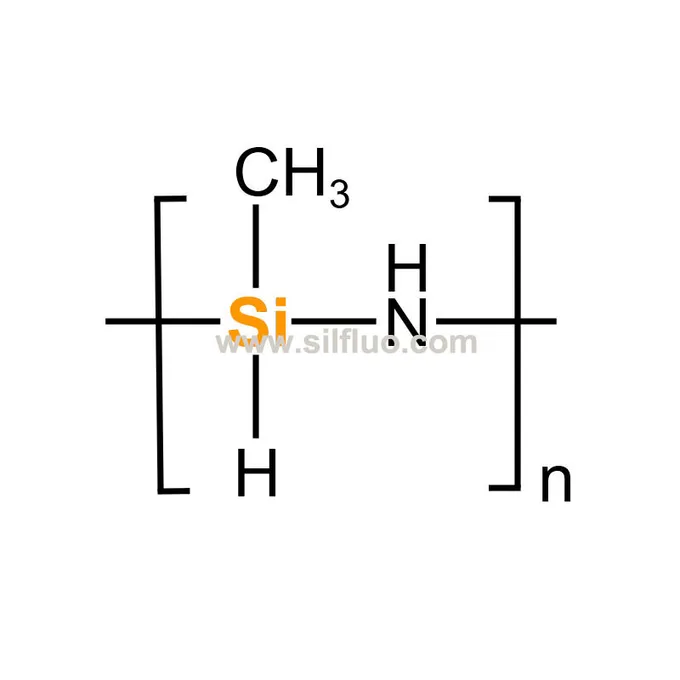
Product Overview
Molecular weight is what separates it from SILZ-701: the long backbone builds coherent films and retains more mass on heating. Si-H sites remain available for hydrosilylation, and Si-N/Si-H bonds react with hydroxyl compounds for curing-agent and modification duty in phenolic, epoxy, alkyd and acrylic systems.
Cured coatings serve continuously at 350 °C (500 °C instantaneous); compounded with heat-resistant nanofillers they withstand direct flame and high-temperature airflow — thin-film protection measured in a 10 µm class.
Key Benefits
Film-grade molecular weight
>8×10⁴ backbone forms coherent, defect-tolerant thin films that low-MW silazanes cannot deliver.
350 °C continuous service
Cured films hold at 350 °C with 500 °C excursions; nanofiller-compounded systems resist direct flame erosion.
≥6H at ~10 µm
Hard, adherent (Grade 0) protection from a film thin enough for precision parts, springs and mesh.
Same Si-H toolbox
Hydrosilylation sites and hydroxyl reactivity carry over — one feedstock for coating, curing-agent and resin-modifier work.
Typical Applications
- Heat-resistance modifier
- Amine curing agent
- Heat/weather-resistance modifier for phenolic, epoxy, alkyd, acrylic resins
Solution guides: Resin, Rubber & Composite Modification
Technical Data
| Test Item | Performance Indicator | Test Method |
|---|---|---|
| Color & Appearance | Pale yellow to colorless transparent liquid | GB/T 1721-79 |
| Viscosity (Ford Cup 4) | 35–50 s | GB/T 1723-1993 |
| Purity | ≥95% | Q/YX 10-2023 |
| Solid Content (120 ± 2°C) | >98% | GB/T 1725-2007 |
| Density | 1.05 ± 0.01 g/mL | GB/T 6750-2007 |
| Relative Molecular Mass | >8×10⁴ | GB/T 27843-2011 |
| Pencil Hardness | ≥6H | GB/T 6739-2006 |
| Adhesion | Grade 0 | GB/T 9286-1998 |
| Salt Spray Resistance | >500 h | GB/T 10125-2021 |
| Reactive Groups | Si-H (methylhydrosilazane, high-MW) |
| Dilution | High viscosity — 50% dilution recommended before application |
| Theoretical Coverage | 12–28 m²/kg |
| Curing Temperature | 180–250 °C |
| Curing Time | 1 h |
| Dry Film Thickness | 10 ± 5 µm (keep ≤15 µm) |
| Working Time (after opening) | 24 h |
| Recommended Operating Temperature | -30 to 300 °C (continuous 350 °C, max 500 °C) |
| Thinner | Aromatics, esters, ethers |
| Flash Point | <22 °C (solvent) |
| Storage Temperature | 0–30 °C |
Values from the SILZ-702 technical data sheet. Complete TDS with test conditions available on request.
Curing & Processing Guidance
The varnish is supplied at 35–50 s (Ford Cup 4); dilute about 50% with aromatic, ester or ether solvents before spraying. Substrate preparation follows Sa 2.5 (minimum St 3, no mill scale), degreased and dry.
Apply one coat at 10 ± 5 µm dry film and keep it at or below 15 µm — over-thick films crack as they densify. Diluted coverage runs 12–28 m²/kg.
Cure at 180–250 °C for about 1 hour. Opened material remains usable for 24 hours. Where your oven cannot hold that window, send the available profile and our lab checks whether the film data still holds before you qualify the grade.
Substrate Compatibility
Carbon steel, stainless steel, cast iron, aluminum alloy, titanium alloy, high-temperature alloy steel, glass-ceramics, ceramics and cement. Formulations are adjusted to substrate and thermal-cycling conditions — describe the part and duty cycle for a confirmed system.
SILZ-702 — Purchasing & Application FAQ
Where does SILZ-702 fit versus SILZ-350?
The two share molecular weight class, film data and cure window. SILZ-350 adds vinyl groups beside Si-H for self-contained crosslinking; SILZ-702 is pure methylhydrosilazane — the cleaner choice when your formulation supplies its own unsaturation or when straightforward Si-H chemistry is wanted.
Why is dilution recommended before spraying?
SILZ-702 ships as a high-viscosity varnish to maximize usable polymer content. Cutting roughly 50% with aromatic, ester or ether solvent brings it to spray viscosity and helps hold the thin 10 µm-class film that performs best.
Can SILZ-702 coatings take direct flame?
Neat films serve to 350 °C continuous / 500 °C instantaneous. For direct flame or high-temperature airflow erosion, use nanofiller-compounded systems built on SILZ-702 — we support the compounding design.
TDS / SDS / COA & Samples
Technical Data Sheet, Safety Data Sheet and batch Certificate of Analysis are available for SILZ-702, and a COA accompanies every shipment. Evaluation samples ship with starting-parameter guidance.
Packaging: Available in 1 kg, 2 kg, 5 kg and 25 kg pails. Store at 0–30 °C in the original sealed container.
SDS & batch COA on request · Reply within 1 business day.