
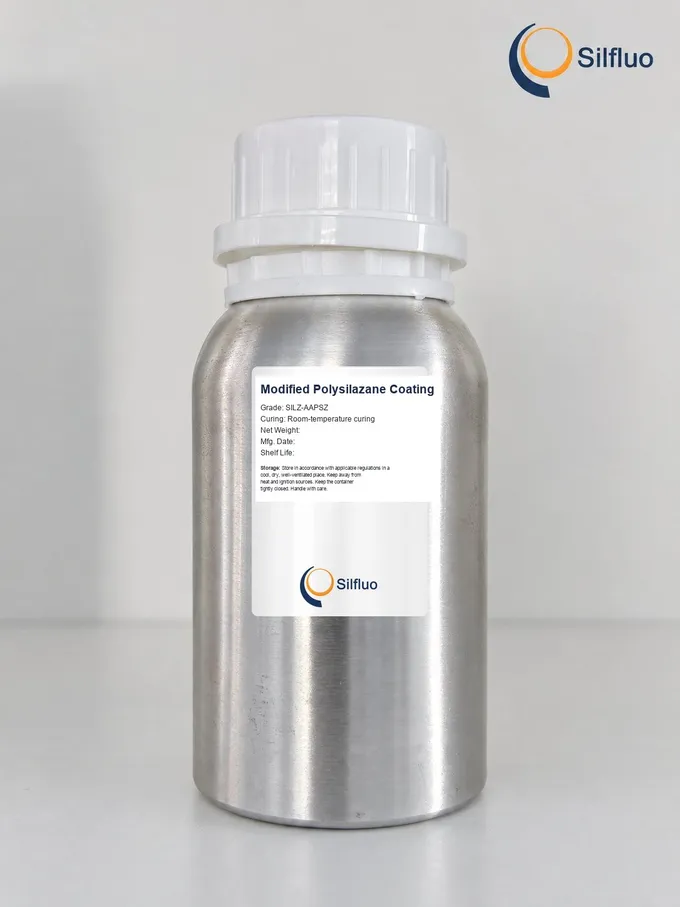
Product Overview
Acrylic modification tunes the polysilazane backbone for optical transparency, weathering and moisture/mildew resistance while keeping covalent substrate bonding. The result reads like two coatings in one: fluoro-class repellency numbers with polysilazane-class hardness and adhesion.
It serves transparent protective and automotive coating systems, hydrophobic anti-graffiti architectural duty, and — via its resin function — adhesives, electronic sealants, flooring and specialty textile auxiliaries. The -50 °C low end covers cold-climate infrastructure most clearcoats abandon.
Key Benefits
>2000 h salt spray in a clearcoat
Corrosion endurance usually reserved for pigmented systems, delivered transparent.
Self-cleaning, anti-graffiti surface
110–115° contact angle sheds water, grime and marker — surfaces rinse clean instead of scrubbing clean.
-50 °C to 280 °C envelope
The widest cold-end rating in our clear line, with 400 °C instantaneous capability.
Bake option for extra hardness
6H off ambient cure; push past 7H with the 150 °C / 30-minute schedule.
Insulation-grade electricals
≥10⁵ V/mm dielectric strength and ≥10¹³ Ω·m resistivity extend it into electronic protection duty.
Typical Applications
- Transparent protective & automotive coatings
- Anti-graffiti/self-cleaning surfaces
- Adhesives & electronic sealants
- Flooring
- Specialty textile auxiliaries
Solution guides: Transparent, Hard & Easy-Clean Surface Protection
Technical Data
| Test Item | Performance Indicator | Test Method |
|---|---|---|
| Component Type | One-component | — |
| Color & Appearance | Pale yellow to colorless transparent liquid | GB/T 1721-1979 |
| Solid Content (120 ± 2°C) | >50% | GB/T 1725-2007 |
| Density | 0.89 ± 0.02 g/mL | GB/T 6750-2007 |
| Pencil Hardness (self-dry / baked) | 6H / >7H | GB/T 6739-2006 |
| Adhesion | Grade 0 | GB/T 9286-1998 |
| Neutral Salt Spray Resistance | >2000 h | GB/T 10125-2021 |
| Water Contact Angle | 110–115° | GB/T 26490-2011 |
| Artificial Aging Resistance | 30 d: no rust, powdering, cracking or discoloration | GB/T 1865-2009 |
| Dielectric Strength | ≥10⁵ V/mm | ASTM D149 |
| Volume Resistivity | ≥10¹³ Ω·m | GB/T 35856-2018 |
| Theoretical Coverage | 10–15 m²/kg |
| Dry Film Thickness | 20–100 µm |
| Curing | Room temperature >24 h, or 150 °C <0.5 h |
| Working Time | 3–6 h |
| Service Temperature | -50 to 280 °C (400 °C instantaneous) |
| Thinner | Esters, xylene, ethers |
Values from the SILZ-AAPSZ technical data sheet. Complete TDS with test conditions available on request.
Curing & Processing Guidance
Prepare and degrease the substrate; for metals target Sa 2.5 (minimum St 3). Glass, ceramics and PV glass need only thorough cleaning and drying.
Spray in one coat at 20–100 µm dry film; coverage runs 10–15 m²/kg. Working time after opening is 3–6 hours.
Cure ambient for >24 hours or at 150 °C for under 30 minutes — bake when you want the >7H hardness tier. The cured surface repels recoats; plan film build in one campaign.
Substrate Compatibility
Stainless steel, glass, cast iron, aluminum alloy, titanium alloy, high-temperature alloy steel, glass-ceramics, ceramics, photovoltaic glass and various fibers. For PV and optical work, we support transmittance validation on your glass spec.
SILZ-AAPSZ — Purchasing & Application FAQ
How does AAPSZ compare with our other hydrophobic clears, RT7 and SIPSZ?
All three cure ambient and repel; they lead on different properties. AAPSZ leads on endurance — >2000 h salt spray with a 110–115° contact angle, a -50 °C cold rating and textile/adhesive resin duty. RT7 leads on hardness and heat-proof clarity (≥8H, non-yellowing to 500 °C). SIPSZ leads on tunable hardness-flexibility with a 380 °C ceiling. Marine, cold-climate or anti-graffiti longevity → AAPSZ.
Can it be used on photovoltaic glass without hurting output?
PV glass is a listed substrate and the film is optically transparent; the self-cleaning surface typically preserves output by keeping soiling off. Validate transmittance on your specific glass and coating thickness — we provide sample panels for that test.
Is baking mandatory?
No — ambient cure delivers the full 6H specification in about a day. Bake at 150 °C only when you want the >7H hardness tier or a faster line turnaround.
TDS / SDS / COA & Samples
Technical Data Sheet, Safety Data Sheet and batch Certificate of Analysis are available for SILZ-AAPSZ, and a COA accompanies every shipment. Evaluation samples ship with starting-parameter guidance.
Packaging: Available in 1 kg, 2 kg, 5 kg and 25 kg pails. Reseal promptly; use within the working window after opening.
SDS & batch COA on request · Reply within 1 business day.