
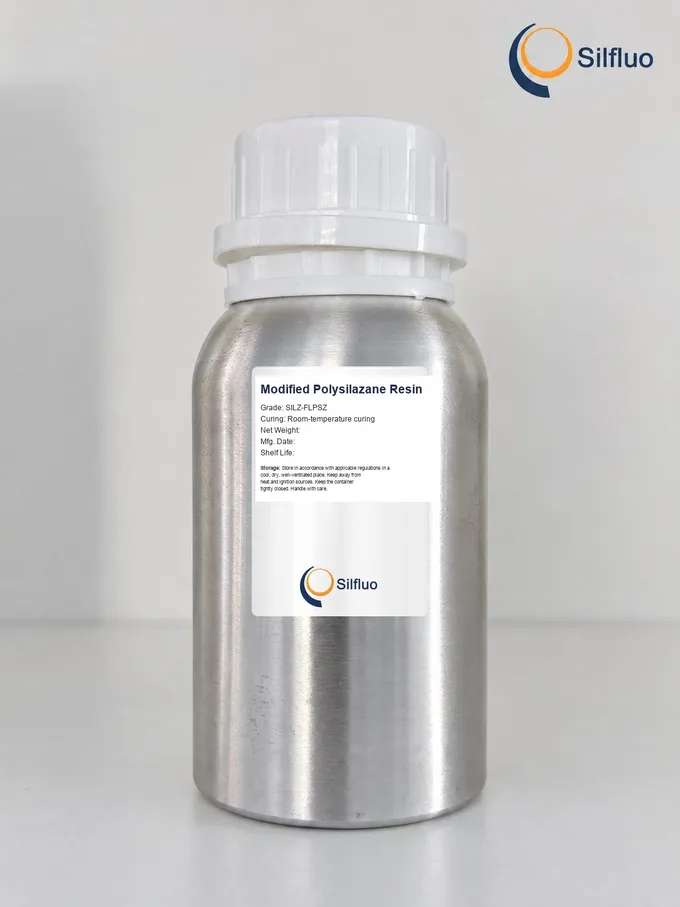
Product Overview
The chemistry is a fluorinated olefin-silicon polymer whose protected reactive groups release on air exposure, driving adhesion, chain extension and crosslinking in one motion. Low initial viscosity lets the coating wet and penetrate surface irregularities before it sets, so the barrier forms from inside the profile — dense against oxygen and moisture where corrosion starts.
Wear numbers match the chemistry: 0.019 g lost over 500 Taber cycles under a 750 g load. Deploy FLPSZ on chemical-plant steel, wastewater facilities, pipelines and mineral substrates facing long immersion service — including leather goods protection, the odd but telling proof of its film flexibility.
Key Benefits
5000 h salt spray — the line record
The highest neutral-salt-spray rating in our functional portfolio, with no blistering, cracking or rust spots at test end.
Half-year immersion in 50% acid and alkali
180 days in 50% H₂SO₄ and 50% NaOH plus 5% NaCl — concentration levels most coatings never see in testing.
300-day wastewater endurance
Ten months in 40 °C chemical wastewater without blistering, peeling or rust — validated for effluent infrastructure.
Penetrating application
Low initial viscosity wets into pores and profile before crosslinking — barrier formation starts below the surface.
Typical Applications
- Heavy-duty anticorrosion on metal & mineral substrates
- Acid/alkali/salt/solvent exposure environments
- Chemical wastewater facilities
Solution guides: Thin-Film & Chemical-Resistant Anti-Corrosion
Technical Data
| Test Item | Performance Indicator | Test Method |
|---|---|---|
| Coating Appearance | Transparent | Visual |
| Component Type | One-component | — |
| Density | 1.02–1.13 g/cm³ | Measured |
| Viscosity at 25 °C | 50–70 s (Ford Cup 4) | GB/T 1723-1993 |
| Adhesion (Cross Cut) | Grade 0 | GB/T 9286-1998 |
| Neutral Salt Spray Resistance | 5000 h: no blistering, cracking or rust spots | GB/T 10125-2021 |
| Chemical Reagent Resistance | 50% H₂SO₄ / 50% NaOH / 5% NaCl: 180 d, no blistering, peeling or rust | — |
| Abrasion Loss | 0.019 g (750 g / 500 cycles, CS10 wheel) | GB/T 1768-2006 |
| Chemical-Wastewater Immersion | 40 °C / 300 d: no blistering, peeling or rust | GB/T 7410-1987 |
| Coating Solids | ≥45% |
| Theoretical Coverage | 10–15 m²/kg |
| Dry Film Thickness | 30–200 µm (≈40 µm per coat, 2–3 coats) |
| Self-Curing | Surface dry 1–6 h · full dry ≈8 h |
| Heat Cure Option | 120–140 °C, <2 h |
| Working Time | ≤3 h (conservative limit) |
| Recommended Service Temperature | -50 to 280 °C (400 °C instantaneous) |
| Thinner | Alkanes, esters, ethers |
| Storage / Shelf Life | 5–35 °C · 12 months |
Values from the SILZ-FLPSZ technical data sheet. Complete TDS with test conditions available on request.
Curing & Processing Guidance
Dry damp substrates and remove oil, loose corrosion and raised defects; repair concrete voids with a compatible filled resin before coating. Metals follow the standard Sa 2.5 / minimum St 3 preparation.
Build the film in 2–3 coats of roughly 40 µm each toward a 100–200 µm total, waiting at least 30 minutes between coats and recoating before full cure — inter-coat chemistry depends on it. Treat 3 hours as the conservative working limit after opening.
Self-curing runs 1–6 hours to surface dry and about 8 hours to full dry, strongly dependent on film thickness, temperature and airflow; 120–140 °C for under 2 hours accelerates when an oven exists.
Substrate Compatibility
Carbon steel, stainless steel, cast iron, aluminum alloy, titanium alloy, high-temperature alloy steel, glass-ceramics, ceramics, cement — and leather. Concrete and mineral substrates take the penetrating application particularly well; confirm pretreatment per substrate with our engineers.
SILZ-FLPSZ — Purchasing & Application FAQ
FLPSZ or FSLPSZ — the sister products look close. Which one?
Choose by your dominant exposure. FLPSZ is the immersion-endurance champion: 5000 h salt spray and 180-day 50% acid/alkali soak make it the pick for long wet service and effluent duty. FSLPSZ answers a different question — hydrofluoric acid and mid-concentration hot acid exposure — with graphene reinforcement. Same temperature envelope; different enemies.
Why must I recoat before full cure?
Each coat's protected reactive groups are still available before full cure, so successive coats bond chemically into one film. Wait past full cure and you are bonding to a finished low-energy surface instead — adhesion drops. Keep the 30-minute-minimum, before-full-cure recoat window.
Does the transparent film show substrate corrosion early?
Yes — transparency is a feature for inspection programs: rust blooms are visible at first formation rather than hidden under pigment. For color-coded systems, ask about pigmented builds.
TDS / SDS / COA & Samples
Technical Data Sheet, Safety Data Sheet and batch Certificate of Analysis are available for SILZ-FLPSZ, and a COA accompanies every shipment. Evaluation samples ship with starting-parameter guidance.
Packaging: Available in 1 kg, 2 kg, 5 kg and 25 kg pails. Shelf life 12 months at 5–35 °C in the original sealed container.
SDS & batch COA on request · Reply within 1 business day.