
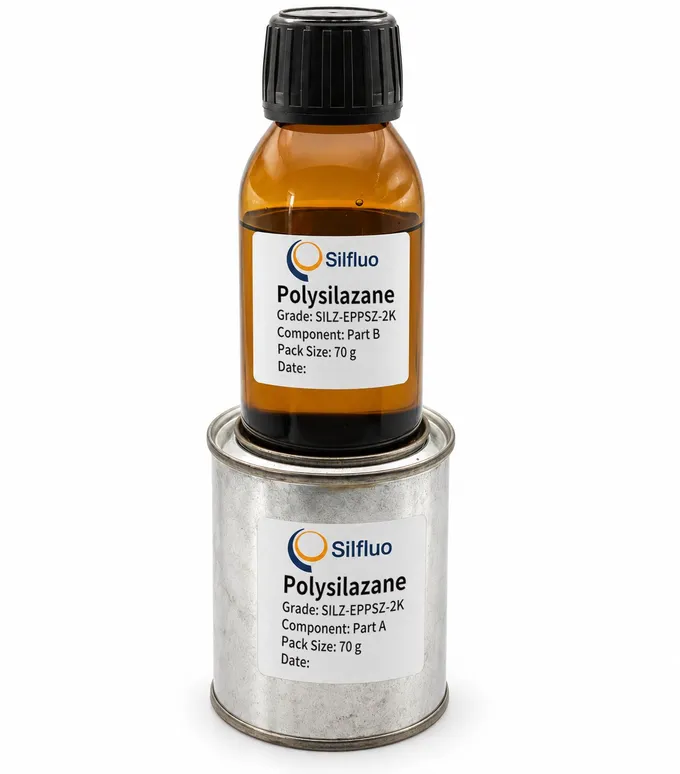
Product Overview
The two-pack format is the point of difference: mixing initiates cure on your schedule, giving consistent through-cure at room temperature (>24 h) or 150 °C in half an hour, independent of ambient humidity. Zinc phosphate and inorganic silicon fillers pack the gray film dense; the epoxy function keeps it tough through thermal cycling.
Deploy it where RT61-class protection meets harder duty cycles: boiler and chemical-plant steel, railway bridges, marine and pipeline work, welds and bolts — and parts that see repeated heating and quenching, backed by the >4-cycle 300 °C thermal-shock test.
Key Benefits
5000 h salt spray at 40 µm
Heavy-duty endurance in a single thin coat — no blistering, cracking or rust spots through 5000 hours.
Verified thermal-shock toughness
300 °C / 1 h followed by water quench, more than 4 cycles without visible cracking (GB/T 30873-2014).
Humidity-independent cure
Two-component chemistry cures by mixing, not moisture — predictable results in dry climates and controlled shops alike.
Simple 1:1 ratio
Equal-parts mixing minimizes metering error; 150 °C / 30 min heat schedule suits production lines.
Typical Applications
- Boiler parts, pipes & valves
- Heat exchangers
- Bridges & marine
- Oil pipelines
- Steel structures, welds & bolts
- Cookware
Solution guides: Thin-Film & Chemical-Resistant Anti-Corrosion
Technical Data
| Test Item | Performance Indicator | Test Method |
|---|---|---|
| Coating Appearance | Gray | Visual |
| Component Type | Two-component, A:B = 1:1 | — |
| Mixed Density | 1.5–1.7 g/cm³ | Measured |
| Mixed Viscosity | 21–30 s | GB/T 1723-1993 |
| Pencil Hardness | ≥5H | GB/T 6739-2006 |
| Adhesion | Grade 0 | GB/T 9286-1998 |
| Neutral Salt Spray Resistance | 5000 h: no blistering, cracking or rust spots | GB/T 10125-2021 |
| Artificial Aging Resistance | 30 d: no rust, powdering or cracking; slight discoloration | GB/T 1865-2009 |
| Thermal-Shock Test | 300 °C / 1 h, water quench >4 cycles: no visible cracking | GB/T 30873-2014 |
| Coating Solids | 65–80% |
| Theoretical Coverage | 6–10 m²/kg |
| Dry Film Thickness | 40 ± 5 µm |
| Curing | Room temperature >24 h, or 150 °C <0.5 h |
| Working Time (mixed) | 6 h |
| Recommended Service Temperature | -30 to 300 °C (400 °C instantaneous) |
| Thinner | Alkanes, esters, ethers |
| Flash Point | <22 °C (solvent) |
| Storage / Shelf Life | 5–35 °C · 6 months |
Values from the SILZ-EPPSZ-2K technical data sheet. Complete TDS with test conditions available on request.
Curing & Processing Guidance
Prepare steel to Sa 2.5 (minimum St 3, no mill scale), degrease, dry. Mix components A and B at 1:1 to full uniformity; mixed viscosity is 21–30 s.
Apply one pass at 40 ± 5 µm dry film (coverage 6–10 m²/kg). Use mixed material within 6 hours.
Cure at room temperature for >24 hours or at 150 °C for under 30 minutes. For thermal-cycling service, a first controlled heat-up to operating temperature conditions the film — ramp guidance ships with the TDS.
Substrate Compatibility
Carbon steel, stainless steel, cast iron, aluminum alloy, titanium alloy, high-temperature alloy steel, glass-ceramics, ceramics and cement. Match pretreatment to substrate and exposure; our technical team confirms systems for mixed-metal assemblies.
SILZ-EPPSZ-2K — Purchasing & Application FAQ
Why choose the two-component EPPSZ-2K over one-component RT61?
Control and duty cycle. Mixing-initiated cure is independent of ambient humidity — decisive for dry climates, thick production schedules and QC-audited shops — and the verified 300 °C water-quench thermal-shock result covers parts that cycle hot and cold. If field simplicity rules, RT61 carries the same 5000 h-class protection in one pack.
How critical is the 1:1 mixing ratio?
Equal parts by design keeps metering forgiving, but complete mixing matters: stir to full uniformity before filtering and spraying. Off-ratio or under-mixed material costs hardness and salt-spray endurance — the TDS includes a quick mix-quality check.
What is the working window after mixing?
6 hours at standard shop temperature. Mix batch sizes to your application rate, and never return mixed material to the component containers.
TDS / SDS / COA & Samples
Technical Data Sheet, Safety Data Sheet and batch Certificate of Analysis are available for SILZ-EPPSZ-2K, and a COA accompanies every shipment. Evaluation samples ship with starting-parameter guidance.
Packaging: Supplied as matched A/B component sets in 1 kg, 2 kg, 5 kg and 25 kg formats. Shelf life 6 months unopened at 5–35 °C.
SDS & batch COA on request · Reply within 1 business day.