
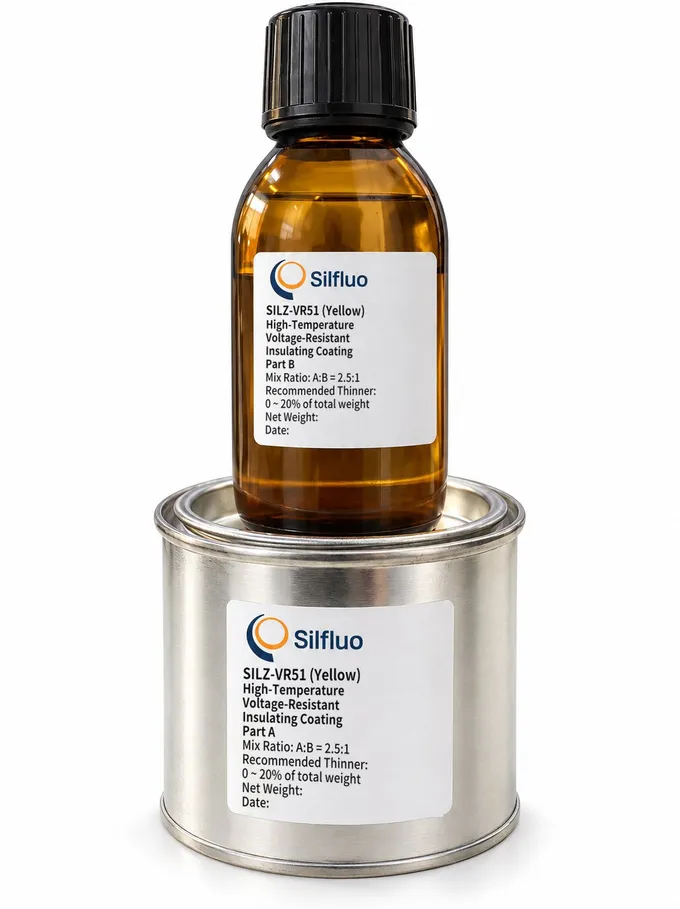
Product Overview
Two technologies carry the rating. A 'tassel-like' branched polysilazane cures into a dense, uniform 3D network whose Si-N bond stability suppresses electron migration under field. Multi-scale insulating fillers — alumina, sericite mica, fumed silica — lock into a skeletal structure, while π-bond-rich stabilizers capture localized micro-currents at the resin-filler interface, eliminating the defects that seed insulation failure.
VR51 protects high-voltage components, enameled and flexible cable systems, power-electronics packaging, photovoltaic equipment, electric-heating elements and stone sealing — conformal-class three-proofing (moisture, salt spray, aging) that happens to be furnace-rated.
Key Benefits
Insulation that survives 500 °C
Dielectric strength ≥10⁵ V/mm holds through continuous 400–500 °C service — the defining spec of this grade.
Defect-suppression architecture
Branched-network resin plus multi-scale fillers and micro-current-capturing stabilizers attack insulation failure at its initiation points.
Five standard colors
Black, white, gray, olive green and yellow (customizable) — color-coding for phase, polarity or inspection zones at temperature.
Flexible cure paths
Full ambient cure for field work, or 180–200 °C for 30 minutes on production lines.
30-day corrosion and aging endurance
Salt spray and artificial aging protocols passed at the same film that carries the voltage.
Typical Applications
- High-voltage insulation
- High-temperature electrical/electronic protection
- Conformal 3-proof coating
Solution guides: Electrical Insulation & Electronics Protection
Technical Data
| Test Item | Performance Indicator | Test Method |
|---|---|---|
| Appearance / Color | Black / white / gray / olive green / yellow (customizable) | Visual |
| Density | 1.75–1.90 g/mL | GB/T 6750-2007 |
| Solid Content (120 ± 2°C) | >45% | GB/T 1725-2007 |
| Pencil Hardness | ≥5H | GB/T 6739-2006 |
| Adhesion | Grade 0 | GB/T 9286-1998 |
| Neutral Salt Spray Resistance | 30 d: no blistering, cracking or rust | GB/T 10125-1997 |
| Artificial Aging Resistance | 30 d: no corrosion, chalking or cracking; slight color change | GB/T 1865-2009 |
| Dielectric Strength | ≥10⁵ V/mm | ASTM D149 |
| Electrical Resistivity | ≥10¹³ Ω·m | GB/T 35856-2018 |
| Dry Film Thickness | 12–100 µm (per pass <40 µm, 5–8 min between passes) |
| Cure @25 °C (RH 70%) | Surface dry 2 h · full cure >5 d |
| Cure @180–200 °C | Surface dry 6 min · full cure 0.5 h |
| Working Time (mixed) | 4 h |
| Service Temperature | Continuous 400–500 °C without cracking, peeling or discoloration |
Values from the SILZ-VR51 technical data sheet. Complete TDS with test conditions available on request.
Curing & Processing Guidance
Prepare to Sa 2.5 (minimum St 3) on metals; degrease and dry. Mix the two components and use within 4 hours.
Build film in thin passes: each coat under 40 µm with 5–8 minutes between passes, to a total of 12–100 µm per design voltage. Spray with standard equipment.
Ambient cure reaches full properties in >5 days (surface dry ~2 h); 180–200 °C compresses full cure to 30 minutes. For rated insulation, run withstand-voltage verification after full cure — test protocols ship with the TDS.
Substrate Compatibility
Aluminum, carbon steel, stainless steel, cast iron and titanium alloys — busbars, housings, heating elements, cable terminations and power-electronics hardware. Also stone sealing duty (anti-mold/moisture). Share your withstand-voltage target and geometry for film-build design.
SILZ-VR51 — Purchasing & Application FAQ
How does film thickness map to withstand voltage?
Design films run 12–100 µm; at ≥10⁵ V/mm dielectric strength, rating scales with validated thickness. We design the film build from your target voltage with safety factor, then confirm by withstand test on your part — not by arithmetic alone.
Can VR51 replace conventional conformal coatings on electronics?
Where boards or components see heat beyond organic conformal limits — power electronics, heater controls, PV combiners — yes, that is its role. For flexible-circuit duty compare PEPSZ; for standard consumer boards a conventional conformal is usually sufficient.
Why the multi-pass application rule?
Thin passes with 5–8 minute flash-off prevent solvent entrapment and pinholes — the enemies of insulation integrity. One thick pass risks micro-defects that no resin chemistry can forgive at 10⁵ V/mm.
TDS / SDS / COA & Samples
Technical Data Sheet, Safety Data Sheet and batch Certificate of Analysis are available for SILZ-VR51, and a COA accompanies every shipment. Evaluation samples ship with starting-parameter guidance.
Packaging: Supplied as matched two-component sets in 1 kg, 2 kg, 5 kg and 25 kg formats. Mixed working time 4 hours.
SDS & batch COA on request · Reply within 1 business day.