
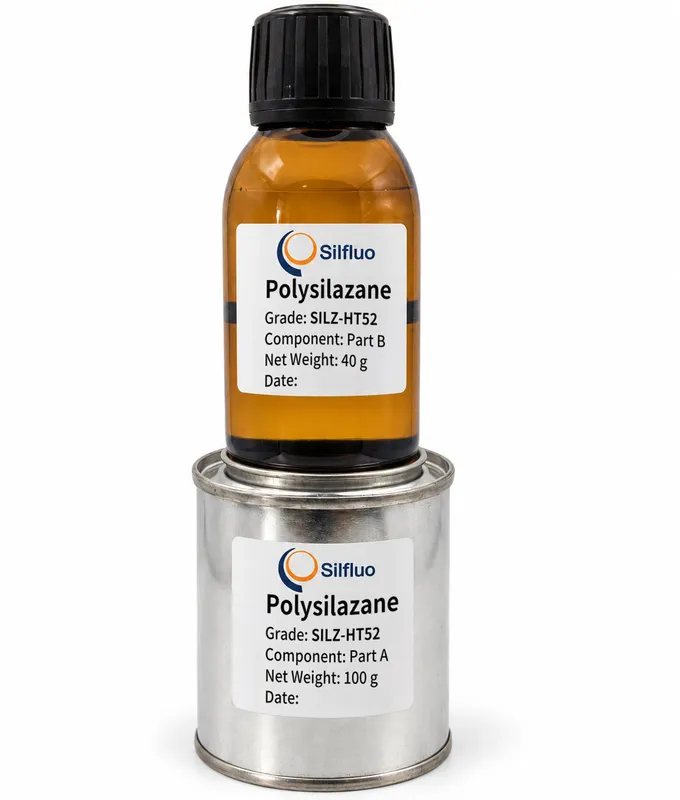
Product Overview
High-temperature ceramic fillers, ultrafine powders and plasticizing fillers ride a polysilazane binder that densifies on cure — the coating becomes fully inorganic in service. The result is ≥8H hardness, high density and salt-spray endurance measured after 800 °C exposure: 30 days without blistering or rust on a film that has already been through the fire.
HT52 is built for the extreme end: ultra-high-temperature furnaces, metallurgical equipment, cracking units, high-temperature reactors, combustion and exhaust systems, and aerospace thermal components — the duty where paint-class chemistry has no business.
Key Benefits
1000 °C / 24 h verified
Documented survival at 1000 °C for 24 hours with no peeling or cracking — capability, not marketing.
Corrosion resistance after the fire
30-day salt spray passed after 800 °C exposure — protection that persists once the coating has fully densified in service.
≥8H cured hardness
A dense cured ceramic film delivers wear resistance for abrasive hot-gas and contact duty.
Two cure routes
Air cure (260 °C or 500 °C, 1 h) covers service to 700 °C; the nitrogen temperature-rise route extends capability to 1300 °C.
Typical Applications
- Ultra-high-temperature furnaces
- Metallurgical equipment
- Cracking units & reactors
- Combustion/exhaust systems
- Aerospace thermal components
Solution guides: High-Temperature Corrosion Protection
Technical Data
| Test Item | Performance Indicator | Test Method |
|---|---|---|
| Appearance / Color | Gray or white | — |
| Solid Content | >85% | GB/T 1725-2007 |
| Density | 1.78–1.95 g/cm³ | Measured |
| Pencil Hardness | ≥8H | GB/T 6739-2006 |
| Adhesion | Grade 0 | GB/T 9286-1998 |
| Neutral Salt Spray Resistance | After 800 °C exposure, 30 d: no blistering or rust | GB/T 1771-2007 |
| Mixed Viscosity | 25–38 s | GB/T 26490-2011 |
| Artificial Aging Resistance | 3 d: no corrosion, chalking, cracking or discoloration | GB/T 1865-2009 |
| High-Temperature Resistance | 1000 °C / 24 h: no peeling or cracking | GB/T 30873-2014 |
| Theoretical Coverage | 8–15 m²/kg |
| Dry Film Thickness | 10–40 µm (keep ≤35 µm) |
| Curing (air) | 260 °C or 500 °C / 1 h |
| Curing (nitrogen) | Temperature-rise curve — consult us; unlocks 1300 °C max |
| Working Time (mixed) | 12 h |
| Recommended Service Temperature | -30 to 800 °C (air-cure max 700 °C; nitrogen-cure max 1300 °C) |
| Diluent | Aromatics, esters, ethers |
| Storage Temperature | 0–30 °C |
Values from the SILZ-HT52 technical data sheet. Complete TDS with test conditions available on request.
Curing & Processing Guidance
Prepare to Sa 2.5 (minimum St 3, no mill scale), degrease, dry. Mix the two components at the project ratio, filter through a 180-mesh screen; mixed pot life is 12 hours.
Spray with a 1.0 mm nozzle or apply by validated scraping at 10–40 µm dry film, keeping ≤35 µm unless a thicker build is qualified for your part.
Air cure at 260 °C or 500 °C for 1 hour depending on system design; for duty beyond air-cure limits, run the nitrogen temperature-rise schedule engineered for your part — contact us for the curve. Plan a controlled first heat-up to service temperature.
Substrate Compatibility
High-temperature alloy steels and stainless grades — 310S/316-class and above. At these temperatures the substrate is a design variable: send alloy, geometry and thermal profile, and we return the qualified system.
SILZ-HT52 — Purchasing & Application FAQ
HT52 or HT53 — the top-end grades look similar. Which is mine?
The two share the ultra-high-temperature architecture and the 1000 °C / 24 h class result. HT52 offers gray or white finishes with the 800 °C-exposed salt-spray protocol; HT53 is the black-gray build with its own verified data set. In practice the choice runs through your color requirement, duty profile and our application review — send both to us and we specify the grade.
What does the nitrogen cure actually involve?
A programmed temperature-rise schedule in a nitrogen atmosphere, engineered per part geometry and mass. It converts the binder further toward pure ceramic, unlocking the 1300 °C maximum. It is furnace work, not a field process — we provide the curve and parameters under an application agreement.
Can HT52 handle abrasive hot gas streams?
The ≥8H cured surface is designed for exactly that class of duty — combustion paths, exhaust and cracking service. For defined particle loadings, share the stream data for an erosion-life estimate.
TDS / SDS / COA & Samples
Technical Data Sheet, Safety Data Sheet and batch Certificate of Analysis are available for SILZ-HT52, and a COA accompanies every shipment. Evaluation samples ship with starting-parameter guidance.
Packaging: Supplied as matched two-component sets in 1 kg, 2 kg, 5 kg and 25 kg pails. Store at 0–30 °C.
SDS & batch COA on request · Reply within 1 business day.