
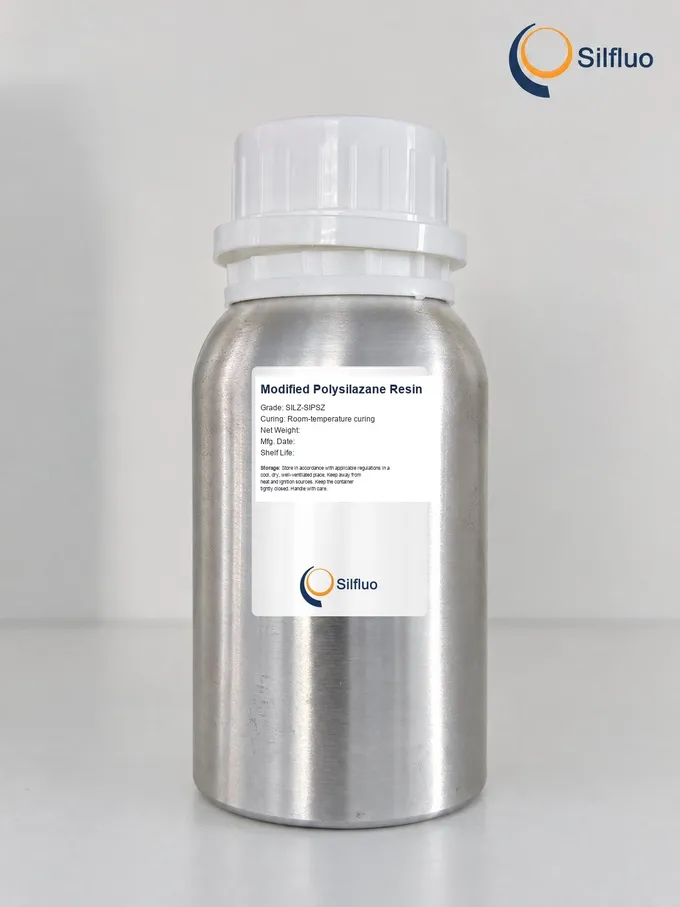
Product Overview
Silicone modification brings toughness, hydrophobic self-cleaning behavior (105–110° contact angle) and thermal headroom; the polysilazane backbone keeps covalent adhesion and Grade 0 bonding. Because the balance lives in the mixing ratio, formulators adjust properties without changing products.
Typical duty: hydrophobic self-cleaning protection, wear- and heat-resistant clear or filled coatings, and electrical-insulation systems (≥10⁵ V/mm, ≥10¹³ Ω·m) where hardness and flexibility both appear on the spec sheet.
Key Benefits
Tunable hardness-flexibility balance
The A:B ratio is a formulation lever: shift toward hardness for wear duty or toughness for cycling parts — one product, a range of films.
>2000 h salt spray
Silicone-armored endurance in clear or filled builds, with 30-day aging resistance and no yellowing.
380 °C service ceiling
-30 to 380 °C recommended range with 430 °C instantaneous — the hottest-running grade among our modified clear systems.
Fast ambient handling
Basic cure in >12 hours at room temperature — quickest ambient turnaround in the functional line — or 140 °C in half an hour.
Typical Applications
- Hydrophobic self-cleaning coatings
- Wear/weather/heat-resistant clear or filled systems
- Electrical insulation with adjustable film properties
Solution guides: Resin, Rubber & Composite Modification
Technical Data
| Test Item | Performance Indicator | Test Method |
|---|---|---|
| Component Type | A/B two-component | — |
| Color & Appearance | Pale yellow to colorless transparent liquid | GB/T 1721-1979 |
| Solid Content (120 ± 2°C) | >50% | GB/T 1725-2007 |
| Density | 0.86 ± 0.02 g/mL | GB/T 6750-2007 |
| Pencil Hardness (self-dry / baked) | 6H / >7H | GB/T 6739-2006 |
| Adhesion | Grade 0 | GB/T 9286-1998 |
| Neutral Salt Spray Resistance | >2000 h | GB/T 10125-2021 |
| Water Contact Angle | 105–110° | GB/T 26490-2011 |
| Artificial Aging Resistance | 30 d: no rust, powdering, cracking or discoloration | GB/T 1865-2009 |
| Dielectric Strength | ≥10⁵ V/mm | ASTM D149 |
| Volume Resistivity | ≥10¹³ Ω·m | GB/T 35856-2018 |
| Theoretical Coverage | 6–8 m²/kg |
| Dry Film Thickness | 20–150 µm (validated builds) |
| Curing | Room temperature >12 h, or 140 °C <0.5 h |
| Working Time (mixed) | 1–2 h |
| Service Temperature | -30 to 380 °C (430 °C instantaneous) |
| Thinner | Butyl esters, xylene, ethers |
Values from the SILZ-SIPSZ technical data sheet. Complete TDS with test conditions available on request.
Curing & Processing Guidance
Prepare substrates to the series standard (metals: Sa 2.5 / minimum St 3; glass and ceramics: clean and dry). Mix A and B at the ratio specified for your property target — we provide the ratio-property map with the TDS.
Apply at 20–150 µm dry film (validated builds); coverage 6–8 m²/kg. Mixed working time is 1–2 hours — batch accordingly.
Cure ambient for >12 hours or at 140 °C for under 30 minutes; baking also unlocks the >7H hardness tier. Validate your chosen ratio on a test panel before production runs.
Substrate Compatibility
Stainless steel, glass, cast iron, aluminum and titanium alloys, high-temperature alloy steel, glass-ceramics, ceramics and photovoltaic glass. Ratio, fillers and pretreatment are matched to the substrate — application-specific validation is part of supply.
SILZ-SIPSZ — Purchasing & Application FAQ
How exactly does the A:B ratio change the film?
Shifting the ratio moves the silicone-to-polysilazane balance: more polysilazane hardens the network (toward >7H baked), more silicone toughens and flexibilizes it. We supply a ratio-property map as the starting point, and your test panel locks the production ratio.
Where does SIPSZ sit versus AAPSZ?
Both are hydrophobic clears in the >2000 h salt-spray class; SIPSZ is the adjustable one. Fixed endurance clearcoat with the higher repellency (110–115°) and the wider cold rating (-50 °C) → AAPSZ. Tunable hardness-flexibility with the higher service ceiling (380 °C, 430 °C instantaneous) → SIPSZ.
The 1–2 hour working time is short — how do lines manage it?
Mix in station-sized batches matched to your application rate, and use the 140 °C flash schedule to clear racks quickly. For continuous lines we help size the mixing cadence; unused mixed material cannot be recovered.
TDS / SDS / COA & Samples
Technical Data Sheet, Safety Data Sheet and batch Certificate of Analysis are available for SILZ-SIPSZ, and a COA accompanies every shipment. Evaluation samples ship with starting-parameter guidance.
Packaging: Supplied as matched A/B component sets in 1 kg, 2 kg, 5 kg and 25 kg formats. Store sealed; mix only what the window allows.
SDS & batch COA on request · Reply within 1 business day.