

Conventional heavy-duty anticorrosion means system thickness: primer, intermediate, topcoat — 250 to 500 µm, three site visits, and weight that bridges, racks and precision parts cannot always carry. Yet the specification behind all that film is usually a salt-spray hour count and a chemical-exposure list.
Polysilazane thin-film systems attack the specification directly. Dense covalent-bonded films of 40–200 µm reach 3000–5000 h neutral salt spray and month-scale immersion in concentrated acid and alkali — endurance conventional systems buy with multiples of the film build. One coat, one visit, kilograms instead of tons on large structures.
The line splits by exposure chemistry: epoxy-modified systems (RT61, EPPSZ-2K) for general steel and infrastructure duty; fluorinated systems (FLPSZ, FSLPSZ) for immersion service and aggressive media including hydrofluoric acid; and the coating-adhesive hybrid EPPSZ where joints and protection overlap.
Service Conditions Covered
| Temperature range | -50 to 300 °C typical service across the line (grade-dependent), with 400 °C instantaneous capability |
| Substrates | Carbon steel first — structures, pipelines, welds, fasteners — plus stainless, cast iron, aluminum, concrete and mineral substrates |
| Media | Neutral salt spray (3000–5000 h class), 50% H₂SO₄ / 50% NaOH immersion (to 180 d), hydrofluoric acid (300 h, FSLPSZ), chemical wastewater (300 d at 40 °C) |
| Film build | 40 ± 5 µm single-coat systems (RT61/EPPSZ-2K) · 30–200 µm multi-coat builds (FLPSZ/FSLPSZ) |
| Curing options | Ambient cure >24 h standard; 120–180 °C accelerated schedules under 2 h where ovens exist |
Recommended Products & Why
| Grade | Format | Curing | Service Temp. | Why this grade |
|---|---|---|---|---|
| SILZ-RT61 | — | >24 h | >200 °C continuous (400 °C instantaneous) | One-component field champion: >5000 h salt spray from a single 40 µm coat — simplest logistics for bridges, pipelines and site maintenance. |
| SILZ-EPPSZ-2K | Two-component, A:B = 1:1 | Room temperature >24 h, or 150 °C <0.5 h | -30 to 300 °C (400 °C instantaneous) | Two-component control: humidity-independent cure and a verified 300 °C water-quench thermal-shock result for QC-audited shops and cycling parts. |
| SILZ-FLPSZ | One-component | Surface dry 1–6 h · full dry ≈8 h | -50 to 280 °C (400 °C instantaneous) | Immersion record-holder — 5000 h spray, 180-day 50% acid/alkali soak, 300-day wastewater — for effluent, tank-adjacent and long-wet service. |
| SILZ-FSLPSZ | One-component (graphene-containing, NCO-terminated) | Surface dry 1 h · full dry ≈8 h | -50 to 280 °C (350 °C instantaneous) | The aggressive-chemistry grade: graphene-reinforced with 300 h hydrofluoric acid and 720 h in 25% H₂SO₄ — etching, pickling and fluoride environments. |
| SILZ-EPPSZ | — | Room temperature >24 h, or 180 °C <0.5 h | -30 to 300 °C (500 °C instantaneous) | Coating-adhesive hybrid: protects and structurally bonds in one chemistry for joints, repairs and mixed assemblies to 300 °C. |
Format, curing and temperature values from each product's TDS.
Samples & Reference Photos
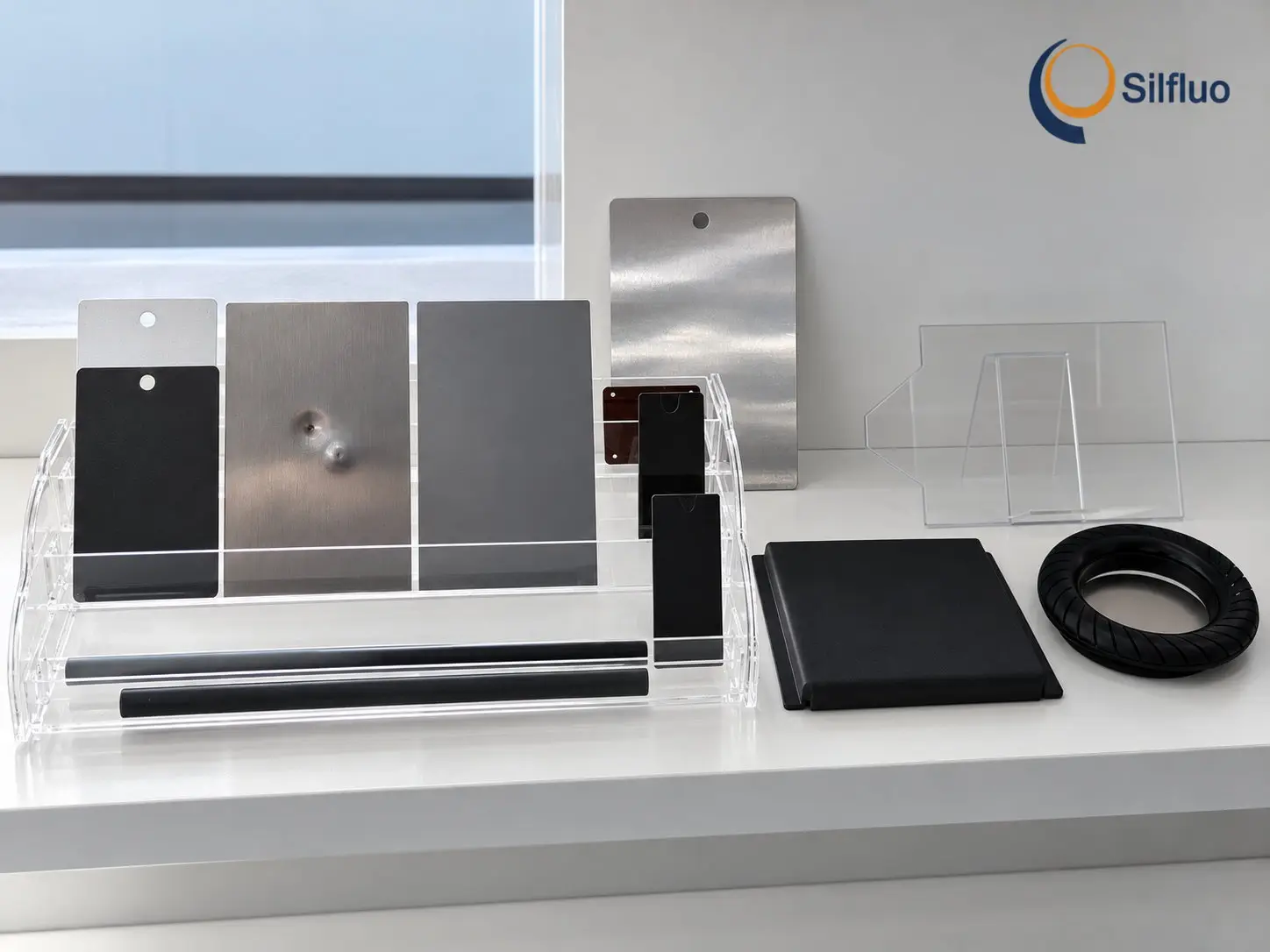
Surface Preparation & Application Principles
Steel preparation follows heavy-duty practice even though the film is thin: Sa 2.5 target, minimum St 3 with no mill scale, fully degreased and dry. Thin films forgive nothing underneath — the profile is the anchor.
Match the coat strategy to the grade: single-pass systems (RT61, EPPSZ-2K) reach specification at 40 ± 5 µm and must not be over-built; multi-coat fluorinated systems (FLPSZ) want ~40 µm per pass with 30-minute minimum intervals, recoating before full cure so the coats fuse chemically.
For immersion and chemical service, qualify the whole system, not the flat panel: edges, welds and fasteners fail first. Run an immersion coupon from the actual bath chemistry — we supply the protocol — before full rollout.
Applicability Boundaries & What We Confirm
- Endurance figures are film-specification results: over- or under-built films void them. Hold the stated DFT windows.
- Chemical-resistance ratings apply to listed media and concentrations; mixed or proprietary streams need coupon validation, which we support.
- These are barrier systems, not cathodic protection: on buried or immersed pipelines with CP systems, compatibility is confirmed case by case.
- Above 300 °C continuous service, move to the high-temperature ceramic line — this line's chemistry peaks at 400 °C instantaneous.
- What we confirm: exposure chemistry and concentration, wet/dry cycling, service temperature, substrate condition, and whether application happens in shop or field.
Discuss your project with an engineer
Send your substrate, service conditions and current coating problem — we reply with a concrete system proposal within 1 business day.