
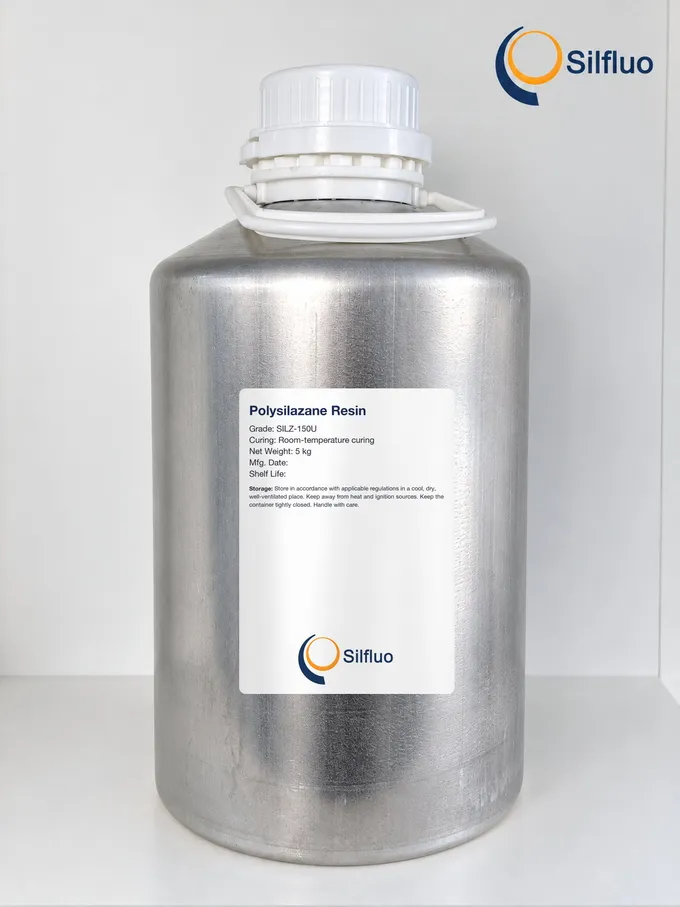
Product Overview
The Si-NH-Si backbone cures by ambient-moisture hydrolysis and oxidation while bonding covalently to substrate hydroxyls — Grade 0 adhesion without a primer. Compared with SILZ-150, the film runs one hardness grade higher (≥7H), the recommended service ceiling rises to 400 °C with 600 °C instantaneous capability, and the resin is characterized for use as a formulation ingredient as much as a neat binder.
Typical roles include the hard phase in insulating and wear-resistant systems, an amine-type curing agent, and a modifier that lifts the heat and weather resistance of phenolic, epoxy, alkyd and acrylic resins.
Key Benefits
≥7H hardness
The hardest film in the room-temperature series — for wear-facing clearcoats and hard-phase duty in formulated systems.
600 °C instantaneous capability
Recommended service to 400 °C with short-term exposure to 600 °C — the widest thermal envelope in the resin line.
Built for formulators
Characterized as a blending resin: predictable reactivity with hydroxyl-functional phenolic, epoxy, alkyd and acrylic systems, plus amine-type curing-agent duty.
No-oven, no-primer application
Room-temperature cure and covalent adhesion keep the process to clean-spray-wait — nothing else.
Typical Applications
- Premium clear ceramic coatings
- High-temperature protection
- Formulation base resin for compounded systems
Solution guides: Electrical Insulation & Electronics ProtectionTransparent, Hard & Easy-Clean Surface ProtectionResin, Rubber & Composite Modification
Technical Data
| Test Item | Performance Indicator | Test Method |
|---|---|---|
| Color & Appearance | Pale yellow to colorless transparent liquid | GB/T 1721-1979 |
| Solid Content (120 ± 2°C) | >98% | GB/T 1725-2007 |
| Density | 0.97 ± 0.1 g/mL | GB/T 6750-2007 |
| Pencil Hardness | ≥7H | GB/T 6739-2006 |
| Adhesion | Grade 0 | GB/T 9286-1998 |
| Neutral Salt Spray Resistance | >500 h | GB/T 10125-2021 |
| Water Contact Angle | >100° | GB/T 26490-2011 |
| Artificial Aging Resistance | 30 d: no rust, powdering, cracking or discoloration | GB/T 1865-2009 |
| Dielectric Strength | ≥10⁵ V/mm | ASTM D149 |
| Volume Resistivity | ≥10¹² Ω·m | GB/T 35856-2018 |
| Coating Solids | >90% |
| Theoretical Coverage | 6–8 m²/kg |
| Dry Film Thickness | 20–50 µm |
| Working Time (after opening) | 4 h |
| Curing Temperature | Room temperature |
| Curing Time (full dry) | >24 h |
| Recommended Service Temperature | -30 to 400 °C |
| Maximum Instantaneous Temperature | 600 °C |
| Thinner | Aromatics, esters, ethers |
| Flash Point | <22 °C (solvent) |
| Storage Temperature / Shelf Life | 5–35 °C · 12 months unopened |
Values from the SILZ-150U technical data sheet. Complete TDS with test conditions available on request.
Curing & Processing Guidance
Surface preparation follows the series standard: Sa 2.5 target (minimum St 3, no mill scale), degrease, and ensure a dry substrate. Filter through a 120-mesh sieve as needed and spray with a 1.0 mm nozzle.
Target 20–50 µm dry film — slightly thinner than SILZ-150 — and expect 6–8 m²/kg theoretical coverage at >90% coating solids. Use opened material within 4 hours.
Full cure takes just over a day (>24 h) at room temperature; the film is handleable well before that. When blending SILZ-150U into your own formulation, add it under dry conditions and account for its moisture reactivity in your pot-life design — our lab shares compatibility data for common resin systems.
Substrate Compatibility
Carbon steel, stainless steel, cast iron, aluminum alloy, titanium alloy, high-temperature alloy steel, glass-ceramics, ceramics and cement — plus, in formulated systems, whatever your base resin already wets. Formulation support for substrate-specific systems is part of the supply.
SILZ-150U — Purchasing & Application FAQ
When should I choose SILZ-150U over SILZ-150 or SILZ-150K?
Choose SILZ-150U when you need the extra hardness grade (≥7H), the wider thermal envelope (400 °C service / 600 °C instantaneous), or when the resin is an ingredient in your own formulation rather than a finished clearcoat. For neat coating use with standard demands, SILZ-150 or the rapid-cure 150K is usually the simpler pick.
Does SILZ-150U have a published CAS number?
No. SILZ-150U is supplied as a formulation-grade product without a public CAS listing; TDS, SDS and batch COA documentation covers identification for import and registration workflows. Contact us for the compliance paperwork your market requires.
How do I handle its moisture reactivity when blending?
Blend under dry conditions, keep containers sealed between additions, and design pot life around ambient humidity. We provide compatibility and pot-life data for common phenolic, epoxy, alkyd and acrylic systems as a starting point.
What sample sizes are available for formulation trials?
Evaluation samples start at 1 kg with TDS and SDS included, and a COA accompanies every shipment. Describe your base system and target properties so the sample comes with relevant starting parameters.
TDS / SDS / COA & Samples
Technical Data Sheet, Safety Data Sheet and batch Certificate of Analysis are available for SILZ-150U, and a COA accompanies every shipment. Evaluation samples ship with starting-parameter guidance.
Packaging: Available in 1 kg, 2 kg, 5 kg and 25 kg pails. Shelf life 12 months in the original unopened container at 5–35 °C.
SDS & batch COA on request · Reply within 1 business day.