

Most resin systems fail upward: the phenolic that chars, the epoxy that softens, the acrylic that chalks — each hits a thermal or weathering ceiling its backbone cannot exceed. Reformulating from scratch is expensive; a reactive additive that grafts heat resistance into the existing system is the shortcut formulators actually take.
Silazanes are that additive. Si-N bonds react with the hydroxyl groups of phenolic, epoxy, alkyd and acrylic resins — behaving as amine-type curing agents while threading heat- and weather-resistant Si-N structure through the network. Si-H grades add hydrosilylation onto unsaturated systems; in silicone and synthetic rubber processing, silazanes serve as structure-control agents that raise vulcanizate heat resistance and mechanical strength.
The modification line runs from mobile reactives (351, 701) for compounding and synthesis to film-grade polymers (350, 702) and pre-modified hybrids (EPPSZ, PEPSZ, SIPSZ) that arrive with the balancing already engineered.
Service Conditions Covered
| Host systems | Phenolic, epoxy, alkyd and acrylic resins (hydroxyl-functional); unsaturated olefin resins; silicone and synthetic rubber compounds |
| Reaction routes | Si-N + hydroxyl (curing-agent behavior) · Si-H hydrosilylation across C=C · vinyl addition chemistry |
| Improvement targets | Heat resistance, weather durability, adhesion, vulcanizate strength, hardness-flexibility balance |
| Dosing | Additive-level loadings established by compounding trials; starting dosages provided per host system |
| Handling | Moisture-reactive feedstocks: dry compounding, sealed storage, pot-life design around ambient humidity |
Recommended Products & Why
| Grade | Format | Curing | Service Temp. | Why this grade |
|---|---|---|---|---|
| SILZ-350 | — | 180–250 °C | -30 to 300 °C (continuous 350 °C, max 500 °C) | Dual Si-H/vinyl high-MW grade: self-contained crosslinking for hybrid networks and the film-capable modifier. |
| SILZ-351 | — | 165–250 °C | — | Low-viscosity vinyl reactive: the easiest-dosing addition platform for rubber processing and custom intermediates. |
| SILZ-701 | — | 165–250 °C | — | Si-H reactive for hydrosilylation onto unsaturated resins — the standard route into organic-inorganic hybrids. |
| SILZ-702 | — | 180–250 °C | -30 to 300 °C (continuous 350 °C, max 500 °C) | High-MW Si-H polymer where the modified system must also form coherent films or high-char structures. |
| SILZ-EPPSZ | — | Room temperature >24 h, or 180 °C <0.5 h | -30 to 300 °C (500 °C instantaneous) | Pre-modified epoxy hybrid: bonding plus heat resistance delivered in one component — modification without the R&D program. |
| SILZ-PEPSZ | — | Room temperature >24 h, or 140 °C / 30–40 min | -30 to 300 °C | Pre-modified polyester hybrid: flexibility and wet-heat endurance grafted onto polysilazane hardness chemistry. |
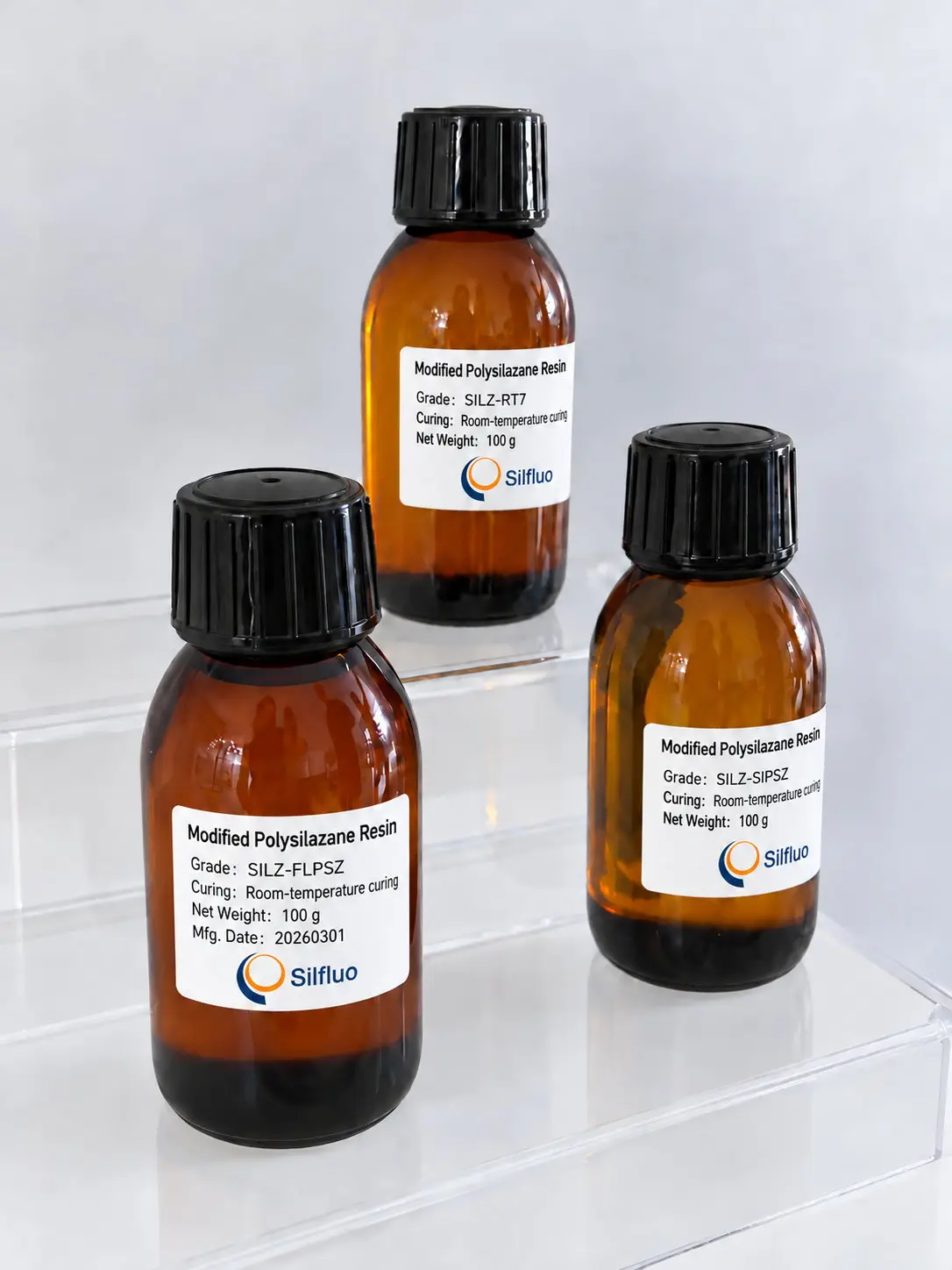
| SILZ-SIPSZ | A/B two-component | Room temperature >12 h, or 140 °C <0.5 h | -30 to 380 °C (430 °C instantaneous) | Silicone hybrid with a tunable A:B ratio — the hardness-flexibility dial for clear and filled systems. |
Format, curing and temperature values from each product's TDS.
The SILZ-150 resin series also serves modification duty — as amine-type curing agents and heat/weather-resistance modifiers for hydroxyl-functional systems — alongside its role as a neat coating binder. For modification-led purchasing, the reactive silazanes above are the primary line; see Organopolysilazane Resins for the 150 series data.
Samples & Reference Photos
Surface Preparation & Application Principles
Dose small, measure, iterate: silazane modification works at additive loadings, and overdosing buys haze or brittleness instead of more heat resistance. Start from our per-system dosage recommendations and lock the level by property testing.
Compound dry: Si-N and Si-H bonds spend themselves on ambient moisture before ever meeting your resin if handling is careless. Sealed additions, dry solvents and pot-life design around humidity protect the chemistry you paid for.
In rubber processing, add during compounding per recipe trials — the structure-control benefit and vulcanizate improvements arrive together. We provide starting protocols for silicone gum systems and common synthetic rubbers.
Applicability Boundaries & What We Confirm
- Improvement magnitudes are host-system-dependent: the same silazane lifts one epoxy 40 °C and another 15 °C. Trials decide, and we say so up front.
- Hydrosilylation requires catalysis (Pt-family) with inhibitor design matched to your pot-life needs — catalysis starting points provided with samples.
- Food-contact, medical and other regulated end uses require application-specific compliance review of the modified system.
- What we confirm: host resin and its functional groups, target property lift, processing temperature window, and whether you need reactive feedstock or a pre-modified hybrid.
Discuss your project with an engineer
Send your substrate, service conditions and current coating problem — we reply with a concrete system proposal within 1 business day.