
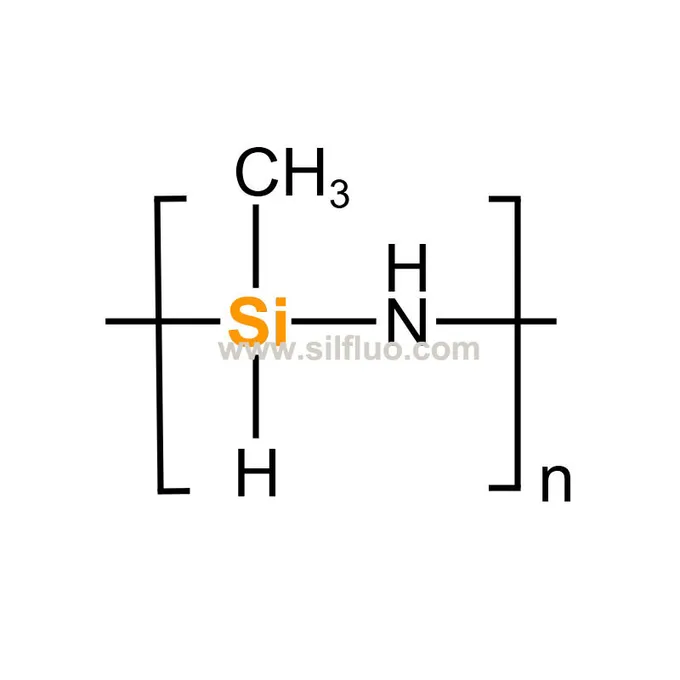
Product Overview
The Si-H bond does the work. It adds across carbon-carbon double bonds (hydrosilylation) to modify unsaturated olefin resins; together with Si-N it reacts with hydroxyl-containing substances, upgrading the heat and weather resistance of phenolic, epoxy, alkyd and acrylic systems.
With molecular weight 177–581 and viscosity spanning 11–60 s, SILZ-701 slots into synthesis, compounding and impregnation workflows; in rubber processing it serves as a structure-control additive that also lifts vulcanizate heat resistance and mechanical strength.
Key Benefits
Si-H functionality
Dense hydrosilylation sites for addition reactions with vinyl and other unsaturated groups — the standard route into hybrid networks.
Two-component crosslinking with vinyl grades
Paired with methylvinylsilazane (SILZ-351), Si-H adds across the vinyl groups so the blend builds its network during heat cure instead of waiting on ambient moisture.
Workable viscosity range
11–60 s (Ford Cup 4) covers impregnation to film-forming without heavy dilution.
Resin and rubber upgrading
Amine-type curing-agent duty plus heat/weather-resistance modification for hydroxyl-functional resins; proven additive in silicone rubber processing.
Typical Applications
- Heat-resistance modifier
- Amine-type curing agent
- Resin modification
- Rubber additive
Solution guides: Resin, Rubber & Composite Modification
Technical Data
| Test Item | Performance Indicator | Test Method |
|---|---|---|
| Color & Appearance | Pale yellow to colorless transparent liquid | GB/T 1721-79 |
| Viscosity (Ford Cup 4) | 11–60 s | GB/T 1723-1993 |
| Purity | ≥95% | Q/YX 10-2023 |
| Solid Content (120 ± 2°C) | >98% | GB/T 1725-2007 |
| Density | 1.04 ± 0.01 g/mL | GB/T 6750-2007 |
| Relative Molecular Mass | 177–581 | GB/T 27843-2011 |
| Pencil Hardness | ≥4H | GB/T 6739-2006 |
| Adhesion | Grade 0 | GB/T 9286-1998 |
| Salt Spray Resistance | >500 h | GB/T 10125-2021 |
| Reactive Groups | Si-H (methylhydrosilazane) |
| Curing Temperature | 165–250 °C |
| Cure @165 °C (DFT 5–25 µm, RH 50%) | Surface dry 1 h · full cure 1 h |
| Cure @200–250 °C | Surface dry 0.1 h · full cure 0.5 h |
Values from the SILZ-701 technical data sheet. Complete TDS with test conditions available on request.
Curing & Processing Guidance
Handle under dry conditions; Si-H and Si-N bonds are moisture-reactive. Keep containers sealed between uses.
As a film: apply 5–25 µm dry film and heat-cure — 165 °C gives surface dry and full cure in about an hour each; 200–250 °C shortens surface dry to ~6 minutes and full cure to 30 minutes (50% RH reference). Cured films reach ≥4H hardness with >500 h salt spray.
For two-component work, compound with SILZ-351 (methylvinylsilazane) at ratios from our starting recommendations and crosslink on heating. Hydrosilylation catalysis and cure profiles are application-specific — our lab supports both.
Substrate Compatibility
As a coating: common metallic and ceramic substrates after standard preparation. As an intermediate: unsaturated olefin resins, hydroxyl-functional resin systems, silicone and synthetic rubber compounds — governed by your matrix chemistry.
SILZ-701 — Purchasing & Application FAQ
SILZ-701 vs SILZ-702 — which methylhydrosilazane do I need?
SILZ-701 is the low-to-mid molecular weight grade (177–581): mobile, easy to dose, ideal for synthesis, compounding and hydrosilylation work. SILZ-702 runs >8×10⁴ molecular weight for film integrity and high-temperature coating duty. Reaction work → 701; coating binder → 702.
What catalyst does hydrosilylation with SILZ-701 need?
Standard Pt-family hydrosilylation catalysts work; loading and inhibitor choice depend on your olefin partner and pot-life needs. We share catalysis starting points along with samples.
Is SILZ-701 usable as a curing agent on its own?
Yes — Si-N and Si-H bonds react with hydroxyl groups, so it functions as an amine-type curing agent and heat-resistance modifier for phenolic, epoxy, alkyd and acrylic resins at trial-established dosages.
TDS / SDS / COA & Samples
Technical Data Sheet, Safety Data Sheet and batch Certificate of Analysis are available for SILZ-701, and a COA accompanies every shipment. Evaluation samples ship with starting-parameter guidance.
Packaging: Available in 1 kg, 2 kg, 5 kg and 25 kg pails. Keep tightly sealed; the material is moisture-reactive.
SDS & batch COA on request · Reply within 1 business day.