
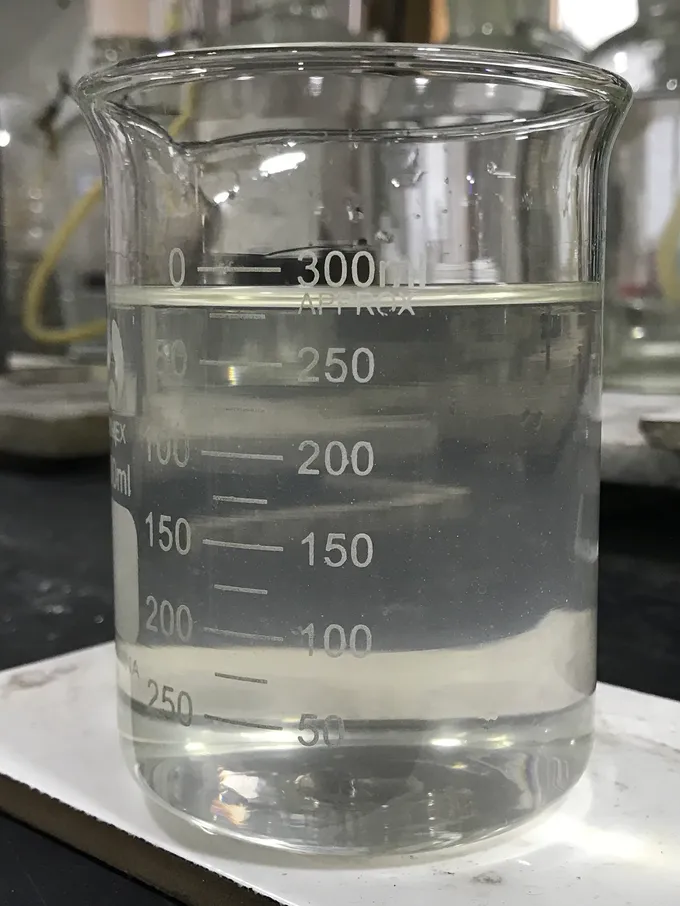
Product Overview
That anchoring separates it from slip and anti-smudge additives that stay mobile in the film: the low-energy surface becomes part of the cured network, so the PFPE segments do not migrate to the substrate interface or bleed out. Silicone and hydrocarbon slip additives give water repellency, but not the oil repellency needed to resist fingerprints and skin oil.
The recommended dosage is 0.1–10%, in UV-curable acrylate, PMMA, PC and PET coating systems. Haze and phase separation are minimized at optimized loadings, but optical clarity should be verified for each formulation and substrate combination.
Key Benefits
Water and oil repellency
Typical contact angles above 100° for water and above 70° for oils and fingerprint sebum on the cured coating.
Anti-fingerprint, easy-clean surfaces
Fingerprints, oily soiling and water droplets adhere less and wipe off more easily.
Bound into the cured film
The acrylic backbone co-cures with the coating resin, so the fluorinated segments stay in place instead of bleeding out.
Smooth, low-friction feel
The PFPE-enriched surface lowers the coefficient of friction, giving a smooth touch on high-contact surfaces.
Fits common acrylic systems
Compatible with UV-curable acrylate, PMMA, PC and PET coatings at recommended dosage.
Typical Applications
- UV-curable anti-fingerprint (AF) coatings for screen protectors, LCD/OLED displays, optical lenses and discs
- Anti-graffiti and anti-fouling topcoats for appliance and consumer electronics casings
- Hardcoats on PC, PMMA and PET for slip, chemical resistance and weathering durability
Solution guides: Easy-Clean & Anti-Fingerprint
Technical Data
| Property | Typical Value |
|---|---|
| Type | PFPE-modified acrylic surface additive |
| Chemical Name | Perfluoropolyether modified acrylic compound |
| Appearance | Translucent liquid |
| Active Content | 30% |
| Contact Angle (typical, cured coating) | Water >100°; oils >70° |
| Supply Form | Additive for UV-curable and acrylic coating systems |
| Recommended Dosage | 0.1–10% |
| Compatible Systems | UV-curable acrylate, PMMA, PC and PET coatings |
| Shelf Life | 12 months unopened, cool, dry and dark |
| Transport Classification | Non-hazardous |
Values from the LS-53C technical data sheet. Complete TDS with test conditions available on request.
Application & Processing Guidance
Add LS-53C to the coating within the recommended 0.1–10% range and mix until uniform. Set the level with a ladder trial, because surface repellency, clarity and adhesion of anything applied on top all change with loading.
Cure the coating as usual — UV for acrylate systems — so the acrylic backbone co-cures or co-polymerizes with the resin. Then check water and oil contact angles, haze and transmission, and easy-clean performance after repeated wiping, on your actual substrate.
Compatible Systems & Substrates
Compatible with UV-curable acrylate, PMMA, PC and PET coating systems at recommended dosage. Typical uses on the TDS are anti-fingerprint coatings for screen protectors, LCD/OLED displays, optical lenses and discs; anti-graffiti and anti-fouling topcoats for appliance and electronics casings; and hardcoats on PC, PMMA and PET.
LS-53C — Purchasing & Application FAQ
What dosage of LS-53C should I start with?
The recommended range is 0.1–10%. Run a ladder series within that range and stop at the lowest level that reaches your contact-angle and easy-clean targets with acceptable haze.
Will LS-53C make my coating hazy?
At optimized loading, phase separation and haze are minimized in compatible systems. Verify clarity in your specific formulation and substrate combination, since resin, solvent and cure conditions all affect it.
Does the repellency survive cleaning?
Because the PFPE segments are bound into the cured film rather than free in it, the TDS describes the anti-smudge and easy-clean effect as maintained through repeated cleaning and UV exposure. Confirm durability with your own wipe or abrasion test and cleaning agents.
Can I print or recoat over a coating containing LS-53C?
It is designed to create a very low-energy surface, which also resists wetting by inks, adhesives and further coats. If the surface has to be printed, bonded or recoated, test adhesion at your addition level before production.
TDS / SDS / COA & Samples
Technical Data Sheet, Safety Data Sheet and batch Certificate of Analysis are available for LS-53C, and a COA accompanies every shipment. Evaluation samples ship with starting-parameter guidance.
Packaging: 1 kg fluorinated bottles, 25 kg pails and 200 kg drums. Shelf life 12 months from manufacture in unopened containers, stored cool, dry and ventilated, away from sunlight, heat and ignition sources.
SDS & batch COA on request · Reply within 1 business day.