
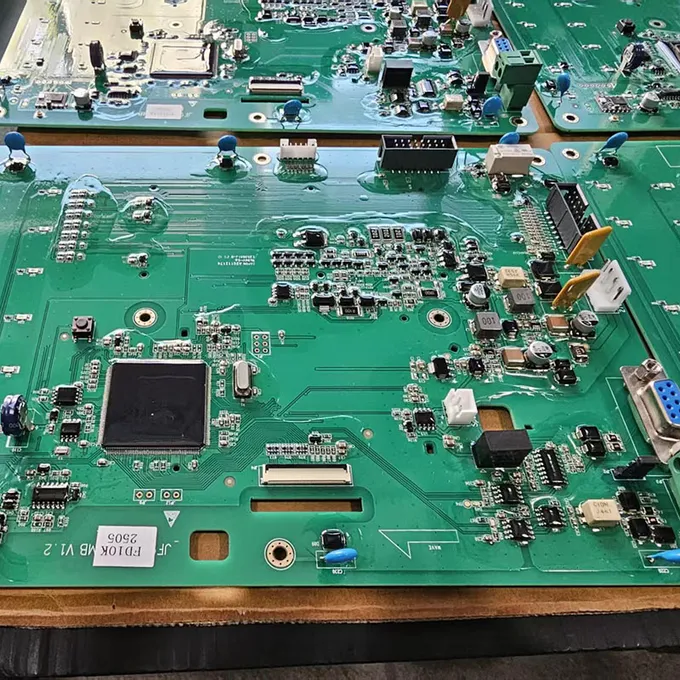
Product Overview
That second cure stage is what separates it from UV-only coatings. Through-hole parts, tall SMD components and connector housings cast shadows that a UV-only film leaves undercured; here those zones reach basic cure in about 3 days at 23 °C and 50% RH, without repositioning boards for extra lamp passes. Ultimate mechanical and electrical properties develop in 7–14 days.
With no solvent, the coating gives off no VOC emissions during application or cure, and the liquid ships as non-dangerous goods. A fluorescent tracer supports coverage checks under 365 nm blacklight, and 199% elongation lets the film follow expansion mismatch between coating and board through thermal cycling — relevant for underhood automotive and outdoor electronics.
Key Benefits
UV cure at line speed
A minimum dose of 1000 mJ/cm² takes the film tack-free, so boards move to inspection and handling without an oven dwell.
Shadowed areas still cure
Moisture completes crosslinking beneath tall and through-hole components, closing the coverage gap of UV-only systems without an extra process step.
Flexible through thermal cycling
199% elongation at break at Shore A 60 lets the film move with the board from −60 to +135 °C without cracking or delaminating.
Insulation values on the TDS
Dielectric strength 23 kV/mm, volume resistivity 3.7×10¹⁴ Ω·cm and a dielectric constant of 3.2 at 1 MHz, measured at 23 °C and 50% RH.
Solvent-free, non-dangerous goods
No solvent to flash off or extract, no VOC emissions in the coating area, and simpler storage and freight as non-dangerous goods.
Typical Applications
- PCB protection in smart meters
- Household and consumer appliance PCBs
- Automotive electronics, including underhood and outdoor modules
- Boards with shadowed areas: through-hole parts, tall SMD components, connector housings
Solution guides: Electronics & PCB
Technical Data
| Property | Typical Value |
|---|---|
| Base Chemistry | Polyurethane acrylate, solvent-free |
| Color | Colorless to pale yellow liquid |
| Viscosity | 150 mPa·s |
| Specific Gravity (23 °C) | 1.10 |
| Adhesion (Cross-Cut Test) | Class 0 |
| Hardness (Shore A) | 60 |
| Tensile Strength | 3.57 MPa |
| Elongation at Break | 199% |
| Volume Resistivity | 3.7×10¹⁴ Ω·cm |
| Dielectric Constant (1 MHz) | 3.2 |
| Dielectric Strength | 23 kV/mm |
| Surface Resistance | 4.3×10¹⁴ Ω |
| Flame Retardancy (UL 94) | V0 |
| UV Inspection | Fluorescent tracer, visible under 365 nm blacklight |
| Service Temperature | -60 to +135 °C |
| Cure Mechanism | UV cure; moisture cure in shadowed areas |
| Surface Dry Energy (minimum UV dose) | 1000 mJ/cm² |
| Shadow-Area Cure (23 °C, 50% RH) | Basic cure ~3 days; ultimate properties 7–14 days |
| Application Methods | Brushing, automated selective spray, dip coating |
| Storage Temperature / Shelf Life | 8–25 °C, dark · 6 months unopened |
| Transport Classification | Non-dangerous goods |
Values from the LC-CC7900-150D technical data sheet. Complete TDS with test conditions available on request.
Application & Curing Guidance
Remove flux residue, dust, grease, fingerprints and ionic contamination before coating, and verify cleanliness with an ion contamination test on critical assemblies. If the material has been stirred, let air bubbles dissipate before use.
Apply by brushing, automated selective spray or dip coating. Keep boards horizontal during coating and the initial UV cure so the wet film does not run on vertical faces. Cure speed depends on lamp intensity, wavelength, film thickness and lamp-to-board distance: deliver at least 1000 mJ/cm² and confirm the cure state with a tack test.
Moisture cure then starts by itself at ambient conditions; higher temperature and humidity accelerate it, and below 40% RH or 15 °C it needs more time. Inspect under 365 nm blacklight after the UV step and touch up skips by brush before the shadowed zones begin to cure. Recoat only over a fully tack-free first layer. Uncured material wipes off with IPA or MEK; cured film needs mechanical abrasion or a dedicated conformal coating remover.
Substrate Compatibility
Formulated for PCB assemblies — solder mask, component bodies and leads, and connector housings — with Class 0 cross-cut adhesion on the TDS. Because the cured film is a tough, crosslinked polyurethane acrylate, plan rework by abrasion or a coating remover, and confirm adhesion on your specific board materials in a line trial.
LC-CC7900-150D — Purchasing & Application FAQ
How long do shadowed areas take to cure?
Basic cure in shadowed areas takes about 3 days at 23 °C and 50% RH; full mechanical and electrical properties need 7–14 days. Boards can be handled after the UV step, but schedule final electrical or environmental testing after the moisture stage.
What UV equipment do I need?
Any lamp system that delivers at least 1000 mJ/cm² at the board surface. Intensity, wavelength, film thickness and lamp-to-board distance all change cure speed, so set the conveyor speed by tack test on your own line.
Can the cured film be reworked?
Uncured material cleans up with IPA or MEK. Once cured, removal needs mechanical abrasion or a dedicated conformal coating remover. If frequent component rework is expected, compare it with the acrylic LC-CC8102, which is designed to be lifted with a remover.
How should LC-CC7900-150D be stored?
Keep containers tightly sealed in a cool, dry, dark place at 8–25 °C. Shelf life is 6 months in unopened packaging, and the product ships as non-dangerous goods.
TDS / SDS / COA & Samples
Technical Data Sheet, Safety Data Sheet and batch Certificate of Analysis are available for LC-CC7900-150D, and a COA accompanies every shipment. Evaluation samples ship with starting-parameter guidance.
Packaging: 1 kg opaque metal cans; 5 kg and larger packs on request. Shelf life 6 months unopened, stored dark at 8–25 °C.
SDS & batch COA on request · Reply within 1 business day.