
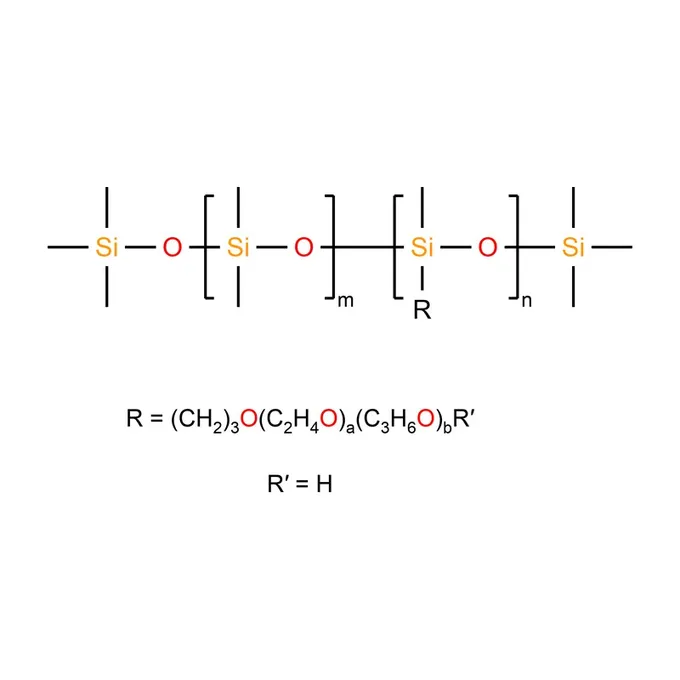
Product Overview
That reactive character is the reason to pick it over the non-reactive grades in this range. A conventional leveling additive stays in the film as a separate component; a reactive one can become part of the resin, which matters to formulators and resin makers who want silicone character built into the binder rather than only added on top. The TDS does not describe the reactive chemistry in detail, so tell us your resin system and we will advise before sampling.
Key Benefits
Wetting and flow in resin coatings
Improves substrate wetting, flow and film uniformity in organic resin coating formulations.
Silicone properties built into the resin
Used as a reactive silicone component, it introduces lubricity, softness and water repellency into the resin itself.
Lowest-viscosity leveling grade
At 200–500 cSt, a colorless to pale yellow liquid at the fluid end of the Silfluo leveling range.
Typical Applications
- Wetting, flow and film uniformity in organic resin coatings
- Reactive silicone modification of resins for lubricity, softness and water repellency
Solution guides: Coatings & Paints
Technical Data
| Property | Typical Value |
|---|---|
| Composition | Polyether-modified silicone |
| Appearance | Colorless to pale yellow liquid |
| Kinematic Viscosity (25 °C) | 200–500 cSt |
| Key Function | Reactive; wetting and leveling |
| Shelf Life | 12 months unopened at room temperature |
| Transport Classification | Non-dangerous goods |
Values from the LF-1221 technical data sheet. Complete TDS with test conditions available on request.
Formulation Guidance
No recommended addition level or reaction conditions are published for LF-1221. Used as an additive, evaluate it in a ladder series against an unmodified control and check wetting, crater count and film uniformity on your substrate.
Used as a reactive modifier, introduce it at the resin synthesis or modification stage, then confirm on the cured film that it has reacted in rather than remaining free — for example with solvent-wipe or extraction tests. In both routes, check surface slip and recoat adhesion, since silicone at the surface can influence both.
Compatible Coating Systems
Described on the TDS for organic resin coatings and for reactive modification of resin formulations. The resin types it reacts with are not listed, so screen it in a small lab batch of your resin system and check clarity, compatibility and cure before scale-up.
LF-1221 — Purchasing & Application FAQ
When should I choose LF-1221 over a non-reactive leveling agent?
When you also want silicone properties — lubricity, softness or water repellency — reacted into the resin, not just a leveling effect. For leveling, slip or crater control alone, the non-reactive grades LF-1344, LF-1400 and LF-1442 are simpler starting points.
What addition level should I start with?
The TDS does not give a recommended level. Run a ladder series in your formulation and compare wetting, flow and appearance with an unmodified control; share the resin system and target properties and we can help plan the trial.
How is LF-1221 packed and shipped?
In 25 kg or 200 kg plastic drums, 200 kg plastic-lined steel drums or 1000 L IBCs, shipped as non-dangerous goods. Shelf life is 12 months unopened at room temperature.
TDS / SDS / COA & Samples
Technical Data Sheet, Safety Data Sheet and batch Certificate of Analysis are available for LF-1221, and a COA accompanies every shipment. Evaluation samples ship with starting-parameter guidance.
Packaging: 25 kg or 200 kg plastic drums, 200 kg plastic-lined steel drums and 1000 L IBCs. Shelf life 12 months from manufacture in unopened containers at room temperature.
SDS & batch COA on request · Reply within 1 business day.