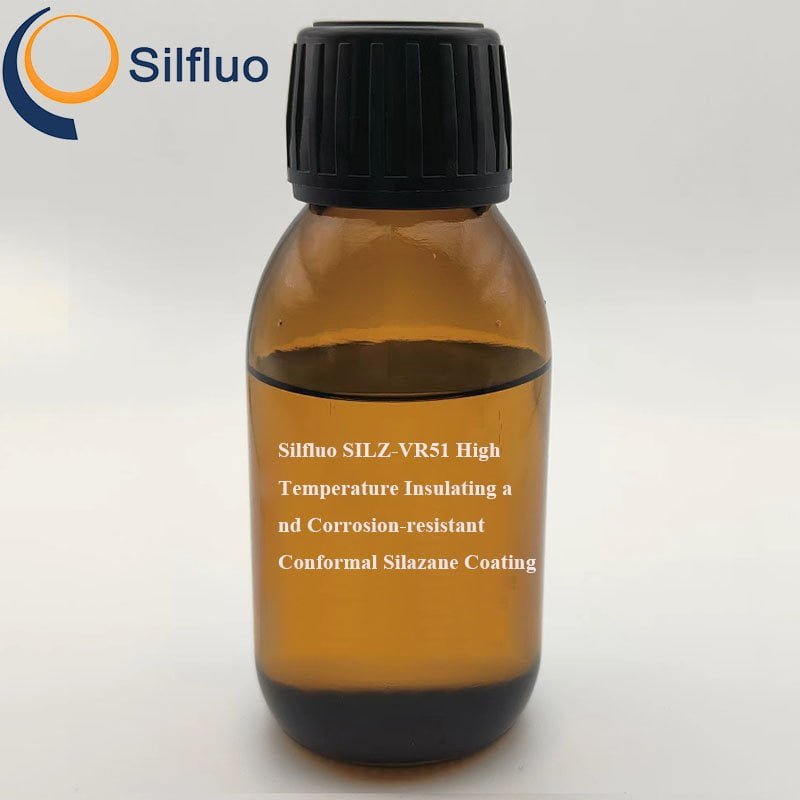
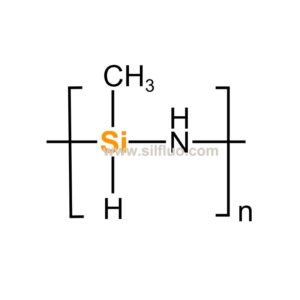
The exceptionally high bond energy and stability of Si–N bonds in polysilazane result in stable molecular orientation under electric fields, effectively suppressing electron migration. Combined with highly insulating and heat-resistant composite fillers, SILZ-VR51 delivers a high-voltage-resistant insulation coating with outstanding comprehensive performance.
1. Molecular structure optimization technology – ultra-high dielectric performance
Through theoretical design and extensive experimental validation, SILZ-VR51 adopts an optimized “tassel-like” branched structure. During curing, this structure forms a dense and uniform three-dimensional crosslinked network. Together with the strong Si–N bonds, the coating achieves excellent mechanical strength and long-term stable electrical insulation performance, with minimal degradation due to aging, wear, or corrosion.
2. Composite filler spatial integration technology – higher density, stability, and integrity
Multiple grades of high-insulation, high-temperature-resistant fillers with different particle sizes and morphologies are strategically combined to form a robust skeletal structure. Special stabilizing additives further enhance resin–filler interfacial bonding, minimizing interfacial defects. Additives containing large π-bond systems can capture localized micro-currents, significantly improving overall performance, including heat resistance, wear resistance, corrosion resistance, aging resistance, strong oxidant resistance, and extended service life.
Special Note: This product is a two-component thermosetting product. Mixed coatings should be used within 4 hours. During extended application periods, ensure application tools are thoroughly cleaned to prevent adhesion. The recommended interval between repeated sprayings is 5-8 minutes, with each coat less than 40µm in thickness.
Standard Processing Procedure: Surface Cleaning → Roughening → Cleaning and Blowing → SILZ-VR51 Treatment → Curing
Instruction Manual
- Roughening: Before coating, grind or sandblast the substrate surface to remove rust, dust, dirt, etc. Roughening significantly affects the coating effect; optimal Sa2.5, minimum St3 (no oxide scale) (GB/T 30790.4-2014), so please pay close attention.
- Cleaning: Use a special cleaning agent or degreaser to remove residual oil, dust, etc., from the roughened surface.
- Substrate Drying: Ensure the substrate surface is dry and clean before coating.
- Coating Mixing: This product is a two-component product. Take an appropriate amount of coating according to the mixing ratio and mix thoroughly. Filter through a 180-mesh filter for later use.
- Coating Application: For laboratory spraying, a 1.0-1.5 mm nozzle spray gun will provide better appearance and uniformity. 6. Curing: For coating thicknesses exceeding 100µm, room temperature curing is recommended. For coating thicknesses below 100µm, either room temperature or high-temperature curing is possible. For film thicknesses of 50-100µm, curing at 180℃ for 40 minutes is recommended. For film thicknesses below 50µm, curing at 180-200℃ for 30 minutes is recommended.