
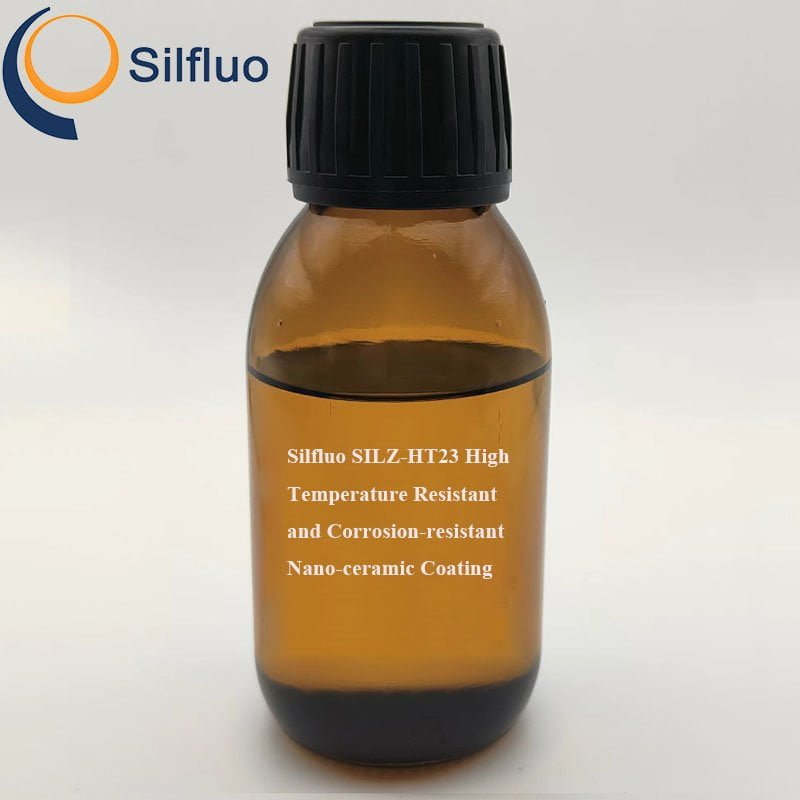
Description of SILZ-HT23 High-Temp Ceramic Coating:
SILZ-HT23 is compounded with functional inorganic fillers including mica powder, titanium dioxide, phosphates, and inorganic silicon powders. After curing, the coating forms a dense, hard, and waterproof ceramic-like layer with excellent resistance to acids, salt spray, aging, and harsh environments.
The cured coating is capable of continuous long-term service at temperatures up to 600 °C, providing reliable protection for metal substrates exposed to severe thermal and corrosive conditions.
SILZ-HT23 is a novel organic–inorganic hybrid high-temperature coating system composed of high-temperature polymer materials, anti-corrosion pigments, ultrafine functional powders, and polymer dispersion technology. After curing, the fillers are densely packed within the polysilazane matrix, resulting in a coating with uniform appearance, moderate gloss, and no obvious macroscopic defects.
The formulation primarily utilizes ionic compounds that form covalent bonds with the substrate during curing, significantly enhancing mechanical strength and adhesion. Acid- and alkali-resistant raw materials ensure excellent chemical stability, while lamellar and rod-like filler structures improve UV resistance and crack resistance, enabling effective resistance to environmental degradation.
Applications
SILZ-HT23 has been widely applied in aerospace, petrochemical, metallurgy, power generation, and defense industries. Typical applications include chimneys and flue ducts, high-temperature steam pipelines, heat exchangers, high-temperature furnaces, desulfurization units, petrochemical cracking equipment, engine components, and exhaust systems.
Technical Specifications
| Test Item | Specification | Test Method |
| Condition in Container | Uniform, no agglomeration | Visual inspection |
| Color | White | Visual inspection |
| Mixed Viscosity (Ford Cup No.4) | 22–26 s | GB/T 1723-1993 |
| Mixed Density | 1.65–1.75 g/cm³ | Measured |
| Mixing Ratio | A : B = 3 : 1 | — |
| Adhesion | Grade 0 | GB/T 9286-1998 |
| Pencil Hardness | ≥ 4H | GB/T 6739-2006 |
| Chemical Resistance | 5% NaCl 30 d / 5% H₂SO₄ 14 d / 5% HNO₃ 14 d, no corrosion | GB/T 9274-1988 |
| Boiling Water Resistance | 48 h, no change | GB/T 1733-1993 |
| Neutral Salt Spray Resistance | 30 d, no blistering, cracking, or rust | GB/T 10125-1997 |
| Artificial Aging Resistance | 30 d, no rusting, no chalking, no cracking, slight color change | GB/T 1865-2009 |
| Thermal Shock Resistance | 600 °C (1 h) → water quench, >5 cycles, no visible cracking | GB/T 30873-2014 |
Special Note: This product is a two-component, high-temperature curing product. Once opened and mixed, please use within 12 hours. During longer application intervals, ensure application tools are thoroughly cleaned to prevent them from hardening.
Standard Processing Procedure: Surface Cleaning → Roughening → Cleaning and Blowing → SILZ-HT23 Treatment → Curing
Instruction Manual
- Roughening: Before applying methylhydrosilazane, grind or sandblast the substrate surface to remove rust, dust, dirt, etc. Roughening significantly affects the coating effect; optimal Sa2.5, minimum St3 (no oxide scale) (GB/T 30790.4-2014), so please pay close attention.
- Cleaning: Use a special cleaning agent or degreaser to remove residual oil, dust, etc., from the roughened surface.
- Substrate Drying: Ensure the substrate surface is dry and clean before coating.
- Coating Mixing: This product is a two-component product; shake well before use and filter through a 120-mesh filter.
- Coating Application: For best appearance and uniformity, use a 0.5-1.0 mm nozzle spray gun in laboratory spraying. 6. Curing: After spraying, allow to dry to the touch in 10 minutes, then cure at 250±10℃ for 0.5±0.1 hours.
Storage & Transportation
- Store in accordance with national regulations. The storage environment should be dry, cool, and well-ventilated, away from heat and ignition sources. Containers must be tightly sealed and handled with care.
2. Recommended storage temperature: 5–30 °C. Shelf life: 6 months.
3. Reseal containers tightly after opening if not fully used.
4. Prepared but unused coating materials must not be recycled and should be disposed of in accordance with local regulations.
5. Products beyond shelf life may only be used after passing quality inspection.
Packaging
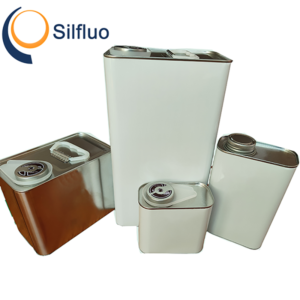
In 1kg, 2kg, 5kg, 25kg pail.